
How a 13 Year Old Built a ₹12 Crore Startup
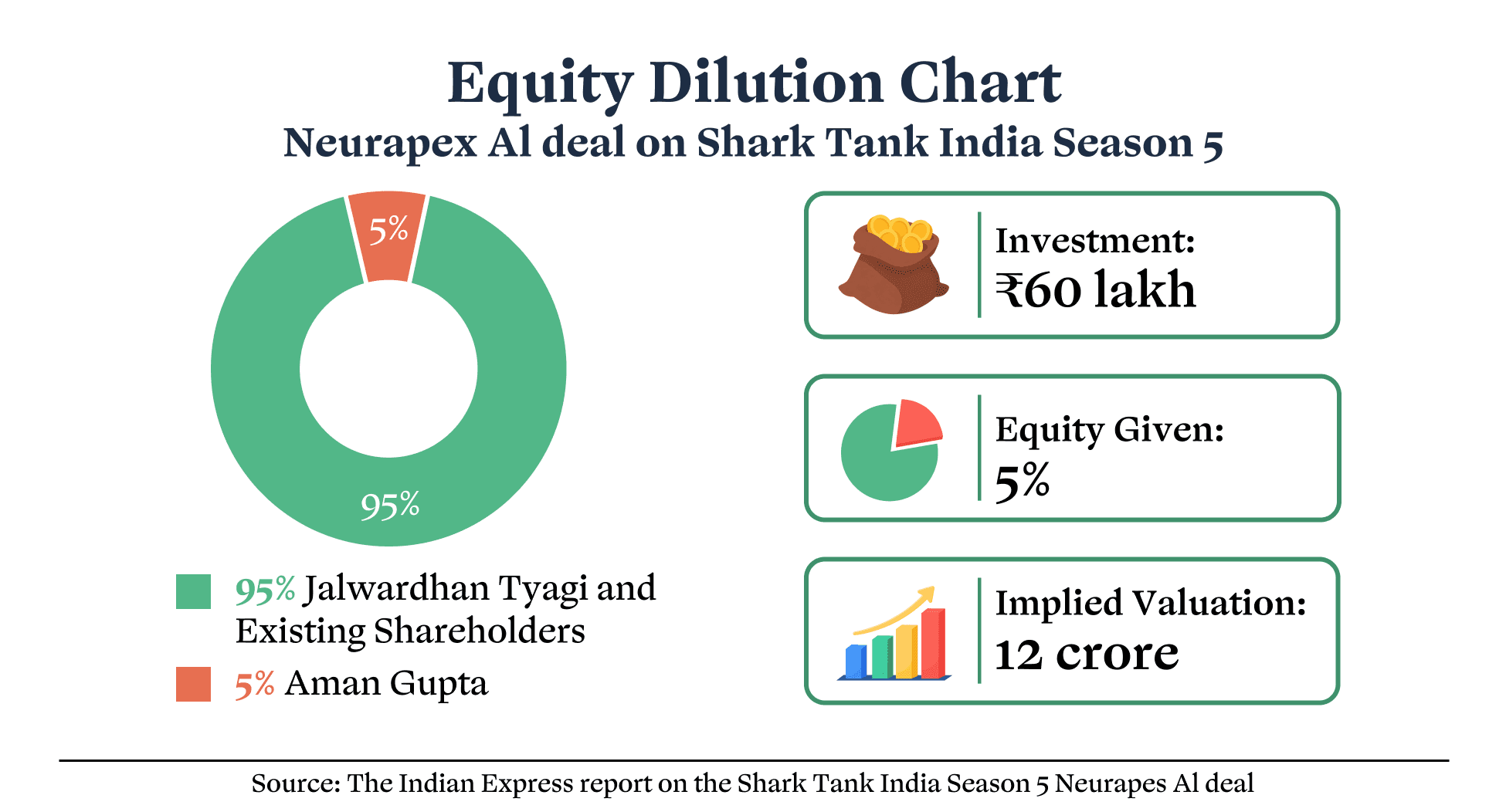
A 13 year old boy walked into Shark Tank India and turned a school age dream into a boardroom conversation. Jaiwardhan Tyagi, introduced on Shark Tank India Season 5 as the founder of Neurapex AI, secured ₹60 lakh for 5% equity from Aman Gupta, placing his young company at a ₹12 crore valuation. Indian Express reported that Neurapexai could analyse MRI scans, lab reports, images, and medical history to generate clear reports, while Neurapex’s own site describes Sentis as a system built to organise fragmented health data into more useful intelligence. The headline feels extraordinary, but the real lesson begins after the applause fades.
The Pitch That Made Age Feel Smaller
Jaiwardhan did not just impress a Shark, he walked in with a problem that adults immediately understood. Healthcare is full of information, yet doctors and patients often struggle to convert that information into fast, clear, reliable insight. Neurapex AI sits inside this gap, using artificial intelligence to read health inputs and support better interpretation, especially in areas like neurological and dermatological analysis. That is why this is more than a young entrepreneur story for social media, because it shows how curiosity becomes valuable when it is aimed at a painful real world problem. The question then becomes what turns curiosity into a company.
Jaiwardhan’s journey reportedly began with chess, block coding, web development, and experiments that did not always work, including an attempt to build an all in one social media website when he was just 10. Those details matter because innovation rarely begins with a polished business plan. It usually begins with small experiments, half finished projects, and repeated attempts to understand how things work. Many families dismiss these as hobbies, but the market often rewards the person who keeps playing with the problem. That is where the first financial lesson quietly enters the story.
Sixty Lakh Is Not Prize Money
When a founder raises ₹60 lakh, it can sound like a reward, but in business it is responsibility. Investor money is not pocket money, salary, or celebration cash. It is capital that must be allocated carefully between product development, research, clinical validation, technology infrastructure, legal compliance, marketing, hiring, and user acquisition. For an AI healthcare startup, the first rupee should usually protect trust before chasing visibility. That makes capital allocation the invisible boardroom exam after a public pitch. The next challenge is deciding what deserves the first cheque.
In a company like Neurapex AI, a large share of early capital would likely go toward R&D and product reliability. Healthcare AI cannot behave like a buggy app. It needs model testing, data quality checks, medical expert feedback, privacy protection, and a strong process for explaining what the system can and cannot do. Marketing still matters, but a medtech brand grows faster when doctors, patients, hospitals, and caregivers believe the output is dependable. Spending too early on hype can create attention, but spending wisely on product can create trust. That is why ₹60 lakh can either become a runway or a warning.
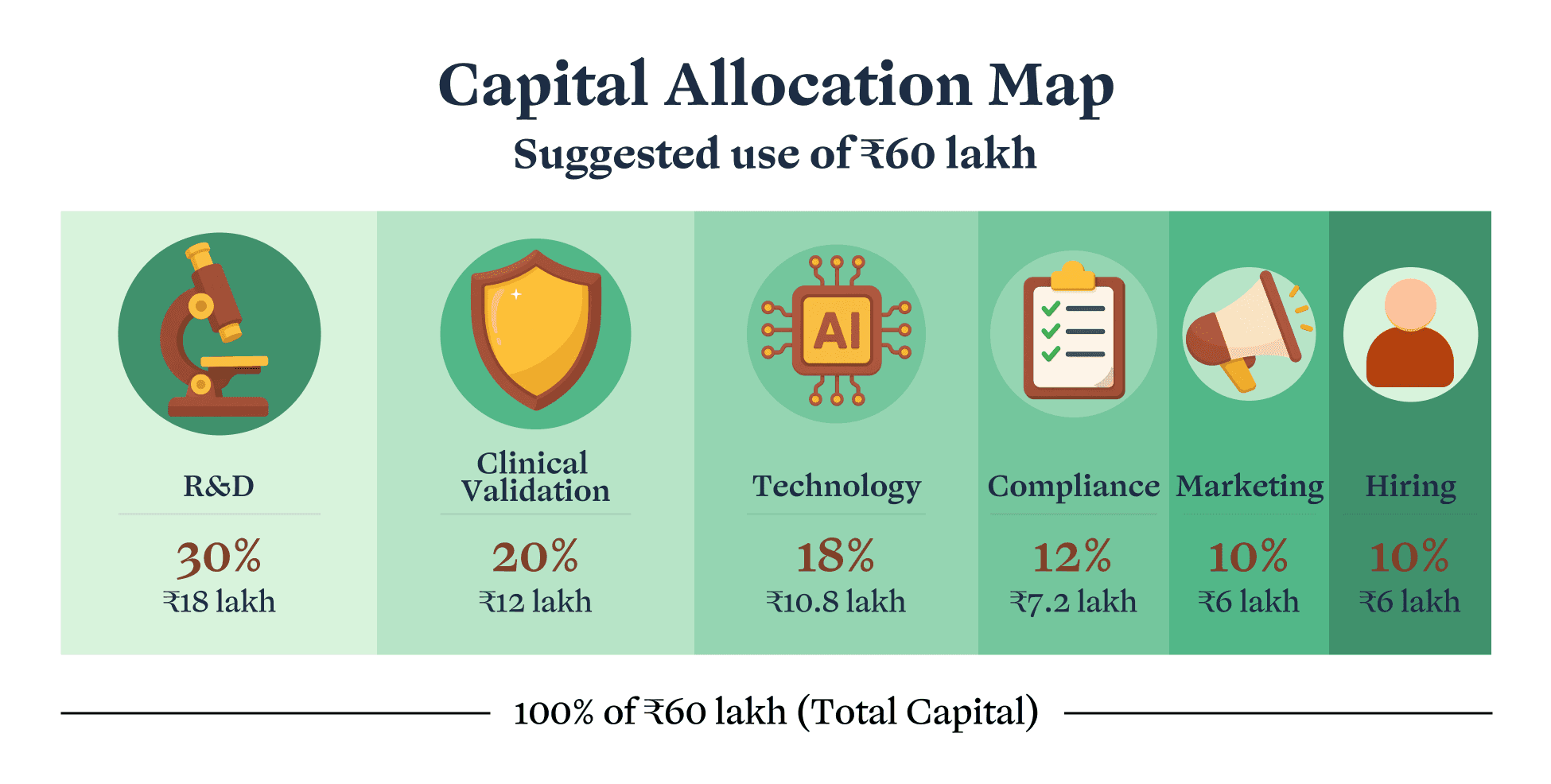
Imagine two spending plans. One founder spends heavily on advertising, gets many downloads, but users leave because the tool is not ready. Another founder spends first on accuracy, expert review, and product depth, then uses marketing to amplify something that already works. The second path may look slower, but it creates stronger compounding because every later rupee of marketing sits on a better product. This is the real meaning of conversations of startup funding India often miss. Funding is not the win, because deployment is where the story proves itself.
Why Equity Beat a Bank Loan
Jaiwardhan gave away 5% of his company instead of taking a loan, and that choice explains equity and debt. Debt is borrowed money that must be repaid with interest, whether the business succeeds quickly or struggles for months. Equity is money given in exchange for ownership, which means the investor shares the upside if the company grows and also shares the risk if it takes longer. For an early stage venture, debt can feel heavy because repayment starts before stable cash flow. Equity gives breathing room, but it also means sharing the future. The tradeoff is simple to understand, yet difficult to decide.
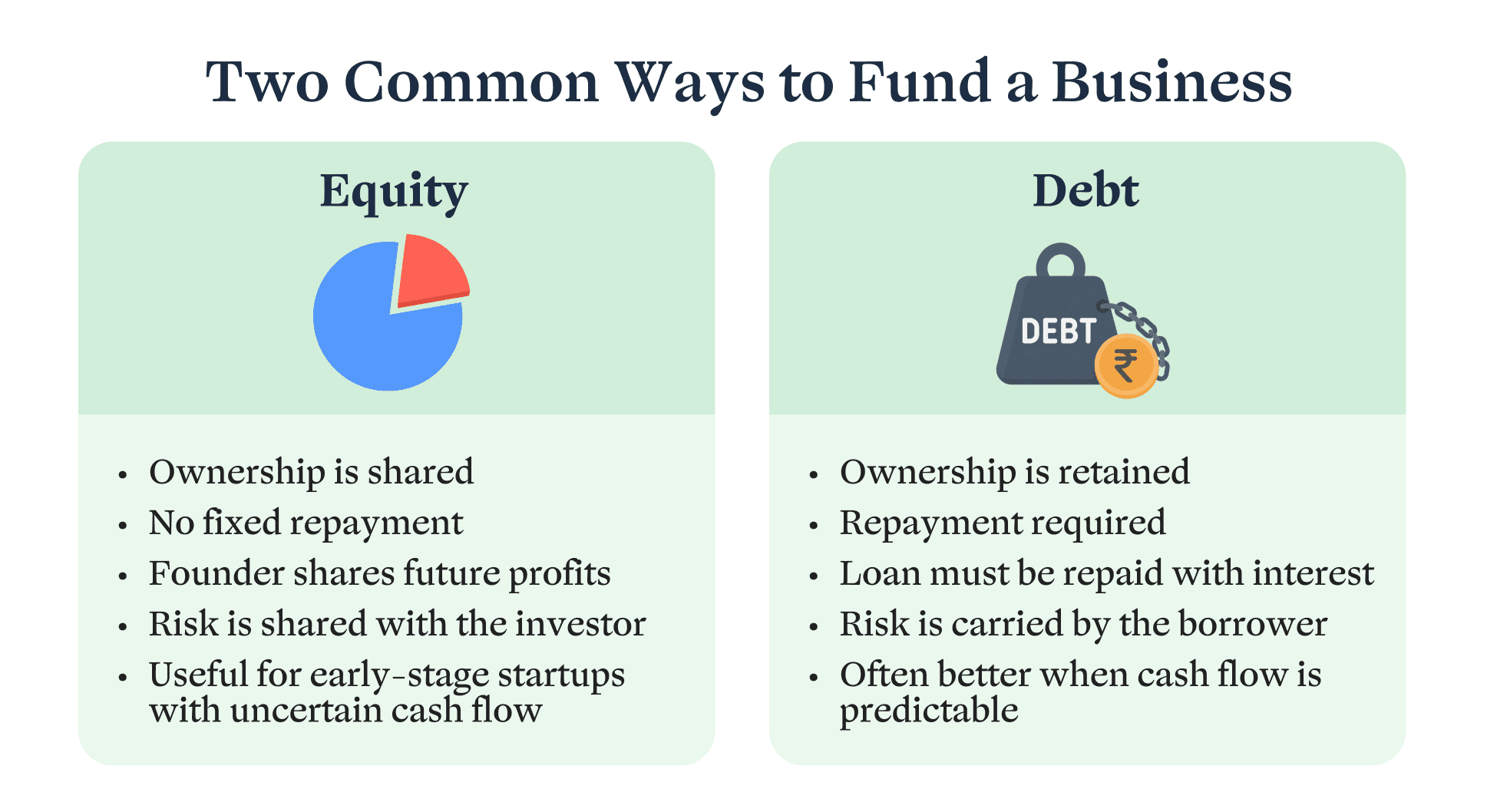
In this case, ₹60 lakh for 5% meant Aman Gupta was buying a small slice of the company instead of expecting fixed repayments. If the business fails, the investor may lose money, but the founder is not trapped in monthly EMIs. If the business grows from ₹12 crore to ₹120 crore, that 5% becomes far more valuable. This is why equity funding often suits early stage startups with high uncertainty and high growth potential. It pays for time, guidance, credibility, and risk sharing. The next question is why that small slice could be worth ₹60 lakh today.
The Twelve Crore Question
Valuation is not the same as revenue, profit, or bank balance. A ₹12 crore valuation does not mean Neurapex AI had ₹12 crore sitting in an account. It means the investor accepted that 5% of the business was worth ₹60 lakh, and by simple maths, 100% was worth ₹12 crore. This is the cleanest way to explain startup valuation. If 5% equals ₹60 lakh, then 1% equals ₹12 lakh, and 100% equals ₹12 crore. But the maths is only the surface, because belief sits underneath it.
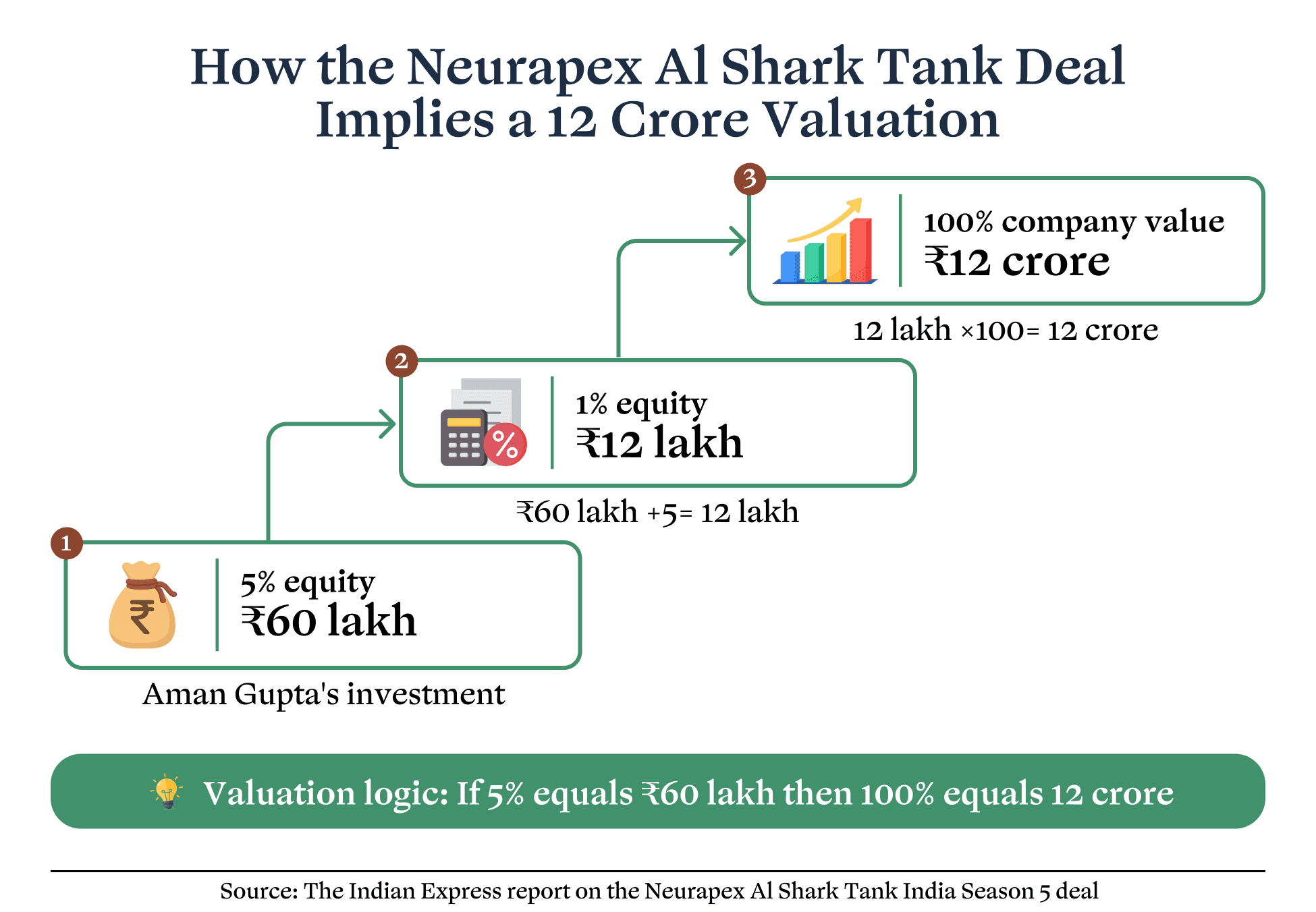
Early stage companies are valued on more than current sales. Investors look at the size of the problem, the founder’s ability, the market timing, product depth, potential defensibility, and the chance that the company could become much bigger. In healthcare AI, the market itself gives investors a reason to pay attention. Grand View Research estimates the global AI in healthcare market at USD 36.67 billion in 2025, with a projected rise to USD 505.59 billion by 2033, while IBEF says India’s medical devices sector is expected to reach USD 50 billion by 2030. Those numbers do not guarantee Neurapex AI’s success, but they explain why the story of a strong medtech startup can attract money. The valuation came from possibility, not certainty.

That is why a Shark may fund a company even when the product is still early. Aman Gupta was not merely paying for software as it existed on pitch day. He was paying for a founder, a market, a category, and the chance to help shape a future. A strong pitch reduces doubt, but it does not erase risk. This is where the Shark Tank lesson becomes more practical than glamorous.
The Shark Was Buying Risk With a Discount
Every investor asks what can go wrong, and whether the upside is large enough. With a teenage founder, the risks are obvious. Education, maturity, execution, compliance, product accuracy, and long term focus all matter. In healthcare AI, the risks become bigger because trust is involved. But risk is not always a reason to say no. Sometimes it is a reason to negotiate ownership, add mentorship, and enter early before the rest of the market notices. That is how risk mitigation turns into investment strategy.
Aman Gupta’s bet can be read as a portfolio decision. He did not need Neurapex AI to be mature on day one. He needed the founder to show rare clarity, the problem to be meaningful, and the price to leave room for future growth. In early investing, the biggest returns often come from recognising talent before it becomes obvious to everyone else. This is why the story ranks among memorable Shark Tank India startup moments. The deal was less about a teenager getting lucky and more about a Shark buying early exposure to an ambitious problem. The sharper lesson is that risk and reward are never separate chapters.
The Compounding Power of Starting Young
Money compounds when returns earn more returns, but skills compound in a similar way. A person who starts building at 13 has years to collect feedback, make mistakes, improve judgement, and learn how markets behave. By the time others are still choosing between safe options, an early builder may already understand product, pricing, pitching, rejection, and resilience. This is the deeper value of business ideas for students in 2026 and the rising interest in youth entrepreneurship. The goal is not to pressure every child to become a founder, but to show that early exposure builds financial thinking before adulthood makes risk feel terrifying. That shift changes how a person looks at opportunity.
India’s ecosystem also makes the timing important. The Government of India reported 2,07,135 DPIIT recognised startups as of 31 December 2025, with more than 21.9 lakh direct jobs generated. That means young people are growing up in an economy where entrepreneurship is no longer rare. The old question was whether one could get a good job. The new question is whether one can also understand how value is created, funded, priced, scaled, and protected. This is where financial literacy for kids becomes more than saving pocket money. It becomes the foundation for reading the world of work.
The Real Lesson Beyond the Cheque
Jaiwardhan Tyagi’s story does not ask us to celebrate age alone. It asks us to notice the habits behind the headline. Curiosity became coding, coding became experiments, experiments became a product, the product became a pitch, and the pitch became capital. Each step required a different kind of intelligence. The lesson is not that every hobby must become a company. The lesson is that hobbies reveal patterns of interest, and those patterns can become serious with patience, feedback, and financial understanding. That is where the story becomes useful beyond Shark Tank.
The ₹12 crore valuation will be remembered because it is dramatic, but the quieter takeaway is more durable. A young founder learnt that ownership has a price, capital has a purpose, risk can be shared, and value is built before it is celebrated. Those are not just startup concepts. They are life concepts hidden inside a television moment. The next Jaiwardhan may not walk into Shark Tank immediately, but somewhere a young mind is already building, failing, adjusting. The question is whether we will recognise the spark before the market does.

Pockvue Solutions Private Limited
#1, CRE Spacez, 2nd Floor, 14th Main Road,
Sector 5, HSR Layout, Bengaluru - 560102