The story behind a hyperlocal delivery business model
Tilak Mehta’s story begins with a problem small enough to disappear inside an ordinary school week.
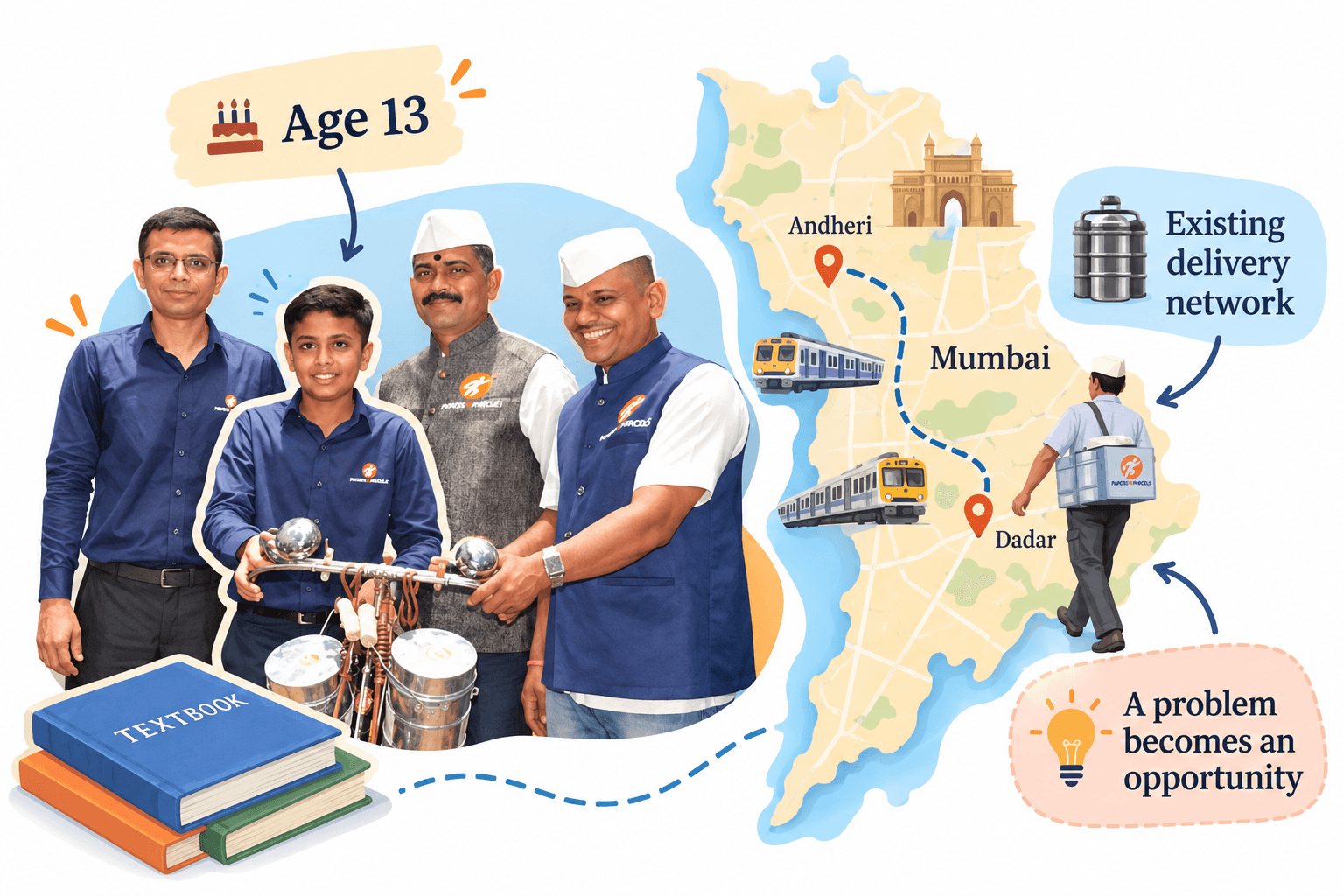
At 13, he faced a problem that many students could relate to. He needed a textbook from another part of Mumbai urgently because he had to prepare for an important school assignment and needed the book immediately. His father had returned home tired, and finding an affordable same-day delivery option seemed almost impossible.
Instead of treating the inconvenience as a one-off problem, Tilak began wondering why there was no affordable way to move small parcels quickly across the city.
That question eventually led to Papers N Parcels.
The opportunity was larger than one forgotten book. Mumbai was full of people who needed documents, medicines, books, and small parcels transported from one part of the city to another without paying premium courier prices or waiting several days. This is the basic logic behind a hyperlocal delivery business model.
Rather than trying to serve an entire country, a hyperlocal service solves a tightly defined problem within a limited geography. Route density matters. Familiarity with neighbourhoods matters. Travel time matters. A delivery network becomes more efficient when many customers and destinations sit within an interconnected urban system.
Papers N Parcels reportedly focused on areas connected through Mumbai’s rail network, used Dadar as an operational hub, and accepted parcels weighing up to three kilograms.
The most interesting part of the story, however, was not the demand Tilak spotted. It was the infrastructure he decided he did not need to build.
Understanding asset-light business model examples through Tilak’s approach
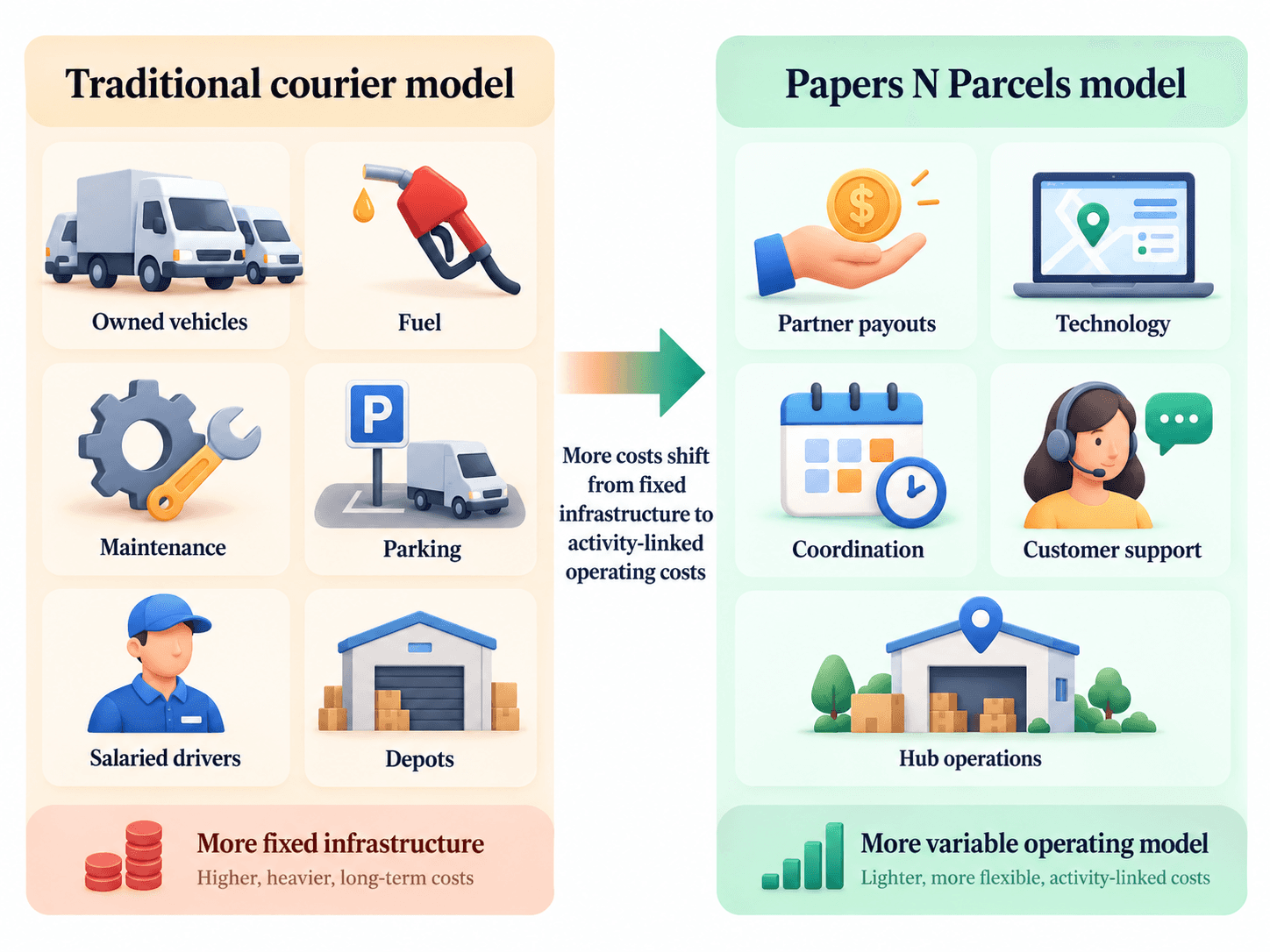
A conventional courier company can become expensive before the first parcel even moves.
Vehicles must be purchased or leased. Drivers need to be hired. Fuel, maintenance, insurance, parking, storage space, and supervision all create recurring expenses. Many of those costs remain even on a slow delivery day. Tilak approached the problem differently.
Building on Mumbai’s trusted Dabbawala network
Instead of creating an entirely new delivery system, Tilak looked at a network that was already moving efficiently through Mumbai every day.
For more than a century, Mumbai’s Dabbawalas had built a reputation for delivering lunchboxes across the city with remarkable precision. Their deep understanding of local routes, neighbourhoods, and railway-connected movement made them a unique logistics network.
Papers N Parcels partnered with Dabbawalas and used part of this existing network for parcel deliveries after lunchbox distribution.
Early reports stated that more than 300 Dabbawalas were associated with the venture and that Papers N Parcels was handling up to 1,200 deliveries per day during its early growth phase. This is what makes the business useful when explaining asset-light business model examples.
An asset-light company does not necessarily own every vehicle, building, or piece of infrastructure required to serve a customer. It focuses instead on controlling the customer experience, coordination, technology, and economics around resources that may already exist.
Imagine that a car is already travelling down a highway with an empty seat. Building another car to transport one additional passenger would be wasteful. Using the spare seat creates value from capacity that was already moving. The Papers N Parcels and Dabbawala partnership worked on a similar principle.
Dabbawalas gained another potential source of income. Papers N Parcels gained access to local knowledge and delivery capacity without recreating an entire citywide fleet from scratch.
But using fewer owned assets only creates an advantage when the economics of every delivery still work, which makes the numbers behind each parcel especially important.
How Papers N Parcels became a lesson in financial education for students in India
Stories about very young founders often become centred on age, revenue, or valuation. That can obscure the more useful lesson.
Building even a small business requires many of the same skills that appear inside a classroom, except every calculation has a visible consequence.
Consider something as simple as choosing a delivery price.
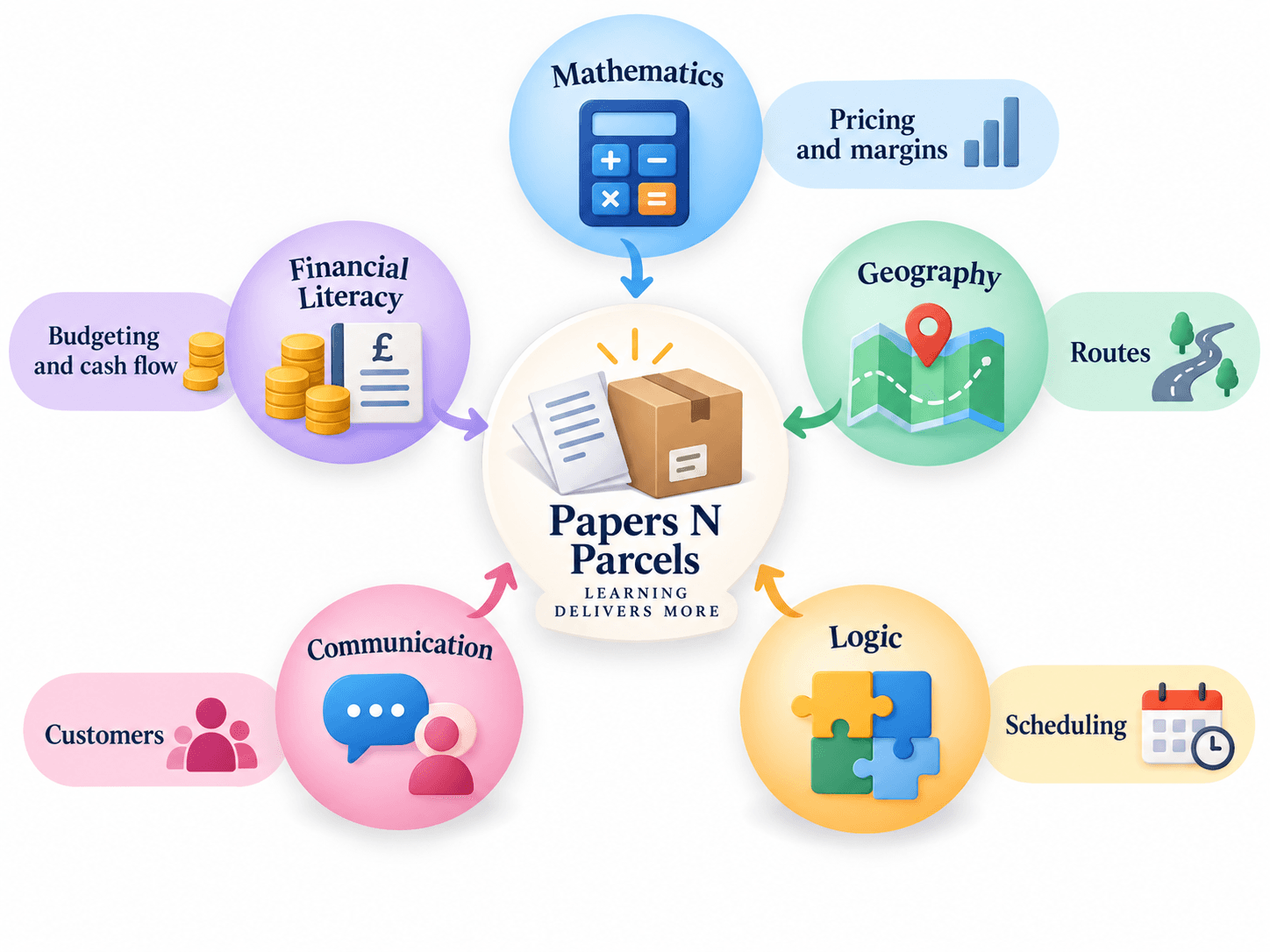
Charge too little and every successful order can lose money. Charge too much and customers may use another service. Suddenly percentages, subtraction, averages, and estimation are no longer worksheet exercises. They influence whether a business survives.
Route planning creates another connection. Geography becomes useful when deciding which neighbourhoods can be served efficiently. Mathematics appears again when estimating travel time and delivery capacity. Communication matters when negotiating with partners or responding to customers. Logic becomes essential when a parcel is delayed and someone must identify where the process failed.
This is where financial education for students in India can move beyond memorising definitions.
A simple project can become an applied laboratory for budgeting, pricing, opportunity cost, profit, negotiation, and risk. The project does not have to resemble Papers N Parcels. A school fair stall, a tutoring experiment, a handmade product, or a neighbourhood service can introduce the same questions.
How much will it cost? What price makes sense? How many customers are required to recover the initial expense? Which resources already exist? What happens when the original plan fails?
Tilak’s story is particularly relevant because contemporary reports also described him continuing with school while managing his entrepreneurial responsibilities with support from his family.
The educational value becomes even clearer once each delivery is reduced to the simplest business question of all. Does one order actually make money?
Breaking down the unit economics for small business behind each delivery
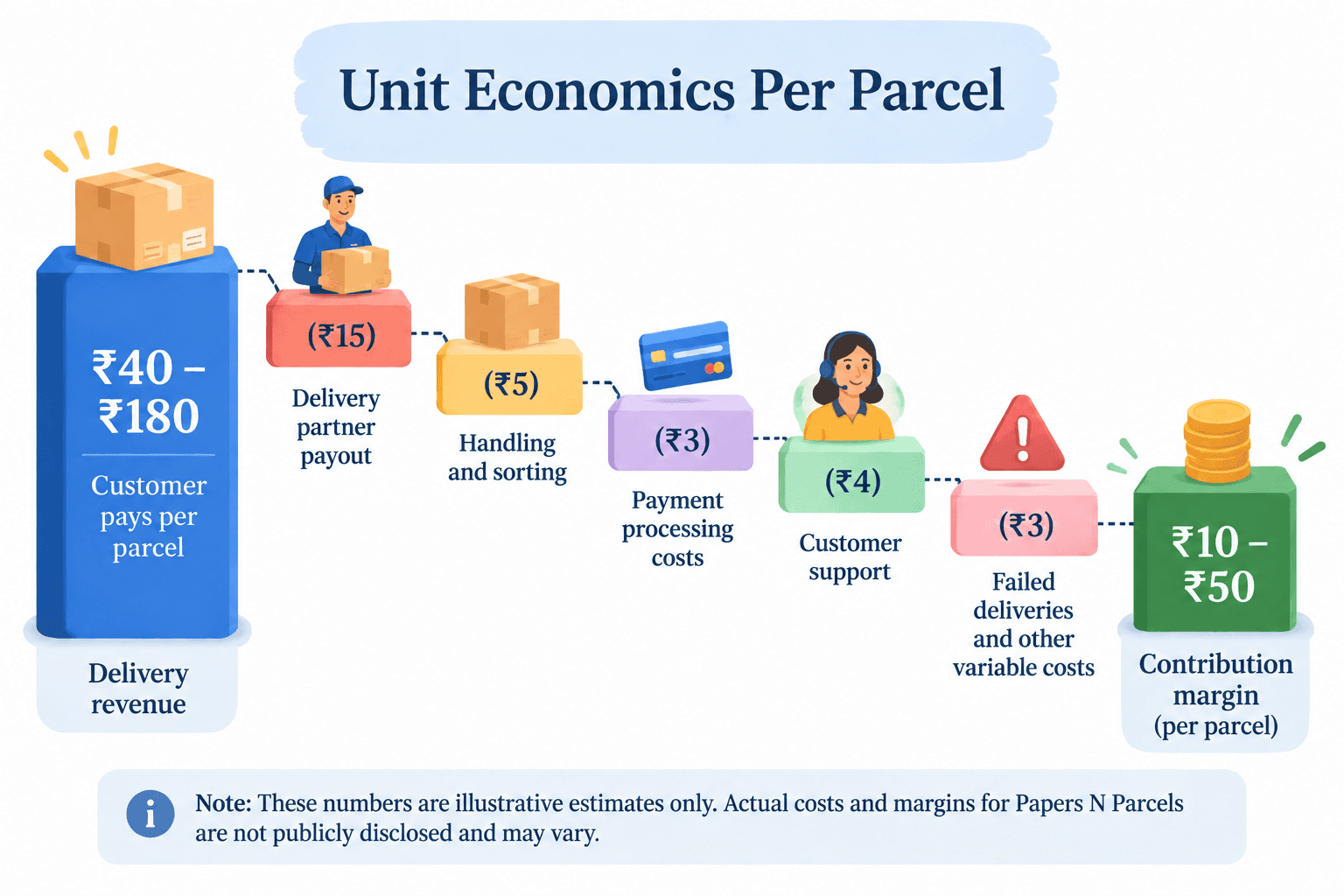
Early reports placed Papers N Parcels delivery charges at approximately ₹40 to ₹180 for parcels weighing up to three kilograms.
That price range is useful, but revenue alone tells us very little.
Understanding unit economics for small business means asking what happens financially every time one unit is sold. In this case, one unit is one parcel delivery.
Suppose a customer pays a delivery fee. That amount is revenue, not profit. The business may still need to pay the delivery partner, payment-processing costs, customer-support expenses, handling charges, technology costs, and the cost of unsuccessful or repeated delivery attempts.
The simplest way to think about it is,
Contribution per parcel = Delivery revenue − Variable cost per parcel
If each successful delivery leaves a healthy contribution after variable expenses, additional orders can help pay for fixed operating costs. If every order loses money, increasing volume can simply increase the speed at which money disappears. This distinction explains why asset-light structures can become powerful.
A company that owns a large fleet may continue paying vehicle financing, salaries, insurance, parking, and maintenance even when order volumes fall. A partnership-led model can make a larger share of expenses move with actual delivery activity.
That does not automatically make the business profitable. Papers N Parcels’ exact internal operating margins are not publicly available in the reliable reports reviewed for this story. This is also where another widely repeated number needs context.
Reports from the company’s early years discussed a target of reaching ₹100 crore in turnover. That figure was an ambition communicated by management, not verified evidence that ₹100 crore in turnover or valuation had already been achieved.
Learning to distinguish revenue from profit and targets from achieved results is exactly the kind of thinking that can make entrepreneurial stories genuinely educational.
Could home be the starting point for an asset-light startup idea?
The most valuable part of Tilak’s experience can be recreated without launching a formal company.
Begin with observation. Ask a young learner to write down three problems they notice repeatedly at school, at home, in an apartment complex, or in the neighbourhood.
Then investigate each one.
Who experiences the problem?
How frequently does it happen?
How is it currently solved?
Would anyone pay for a better solution?
The next step introduces the thinking behind how to start asset-light startup ideas. Before buying anything, ask what already exists.
Could equipment be borrowed?
Could an existing shop provide production?
Could unused space be shared?
Could a local partner handle delivery?
Could free software replace a paid tool during the experiment?
This shifts attention away from ownership and toward resourcefulness.
A simple one-page financial plan can then turn the idea into a learning exercise. Write down the expected selling price, estimated customer count, variable cost per sale, fixed expenses, and break-even quantity.
The first numbers will probably be wrong. That is useful. Comparing an estimate with the actual outcome teaches forecasting far better than being given the correct answer in advance.
Time should be treated as another scarce resource. School, sleep, sport, friends, and family life remain fundamental. A small entrepreneurial experiment works best when it adds meaning to academic concepts instead of competing with everything else.
That balance is what transforms a business experiment from a race for early success into something much more durable. It becomes a way of learning how decisions work in the real world.
And that changes how the famous “young entrepreneur” label should be interpreted.
What the success story of a youngest entrepreneur in India should really teach us
Search for the success story of a youngest entrepreneur in India and the headline numbers are usually what attract attention first.
Age
Revenue
Funding
Valuation
Those details can be interesting, but they are not the strongest reason to tell Tilak Mehta’s story. The more transferable lesson is the sequence of thinking.
A small personal inconvenience revealed a broader customer problem. An existing city network revealed unused capacity. Partnership reduced the need to build expensive infrastructure. Pricing forced attention toward unit economics. Growth depended on whether coordination could scale without destroying service quality.
Each step contains a financial concept that can be understood long before someone studies business formally.
That makes the story particularly useful in conversations around money and entrepreneurship at home. Success does not need to be defined as creating a company at 13. It can mean becoming better at noticing problems, estimating costs, asking sharper questions, testing assumptions, and understanding how resources create value.
Those abilities remain useful whether someone eventually becomes an entrepreneur, engineer, doctor, designer, investor, or employee.
Tilak’s experience is therefore most valuable not as a blueprint that should be copied, but as proof that sophisticated financial thinking can begin with an ordinary problem.
Sometimes a forgotten textbook can teach far more than what is printed inside it!

Newly Launched

Pockvue Solutions Private Limited
#1, CRE Spacez, 2nd Floor, 14th Main Road,
Sector 5, HSR Layout, Bengaluru - 560102