
It Didn’t Start in India, But It Reached Your Wallet
On most days, the value of the rupee feels like a number scrolling quietly at the bottom of a news channel. But when it crosses ₹94 against the dollar, it stops being just a background noise. Rather, it starts becoming a signal that something deeper is shifting beneath the surface of the economy.
What makes this moment different is not just the number, but the story behind it. The fall of the rupee in 2026 isn’t driven by one event; it’s the result of multiple global forces colliding at the same time. And while those forces may seem distant, their impact shows up in the most familiar places: fuel prices, grocery bills, education costs, and even job opportunities.
To understand why the rupee is falling, you have to start with the most powerful trigger behind it all: oil.
The Oil Shock That India Cannot Escape
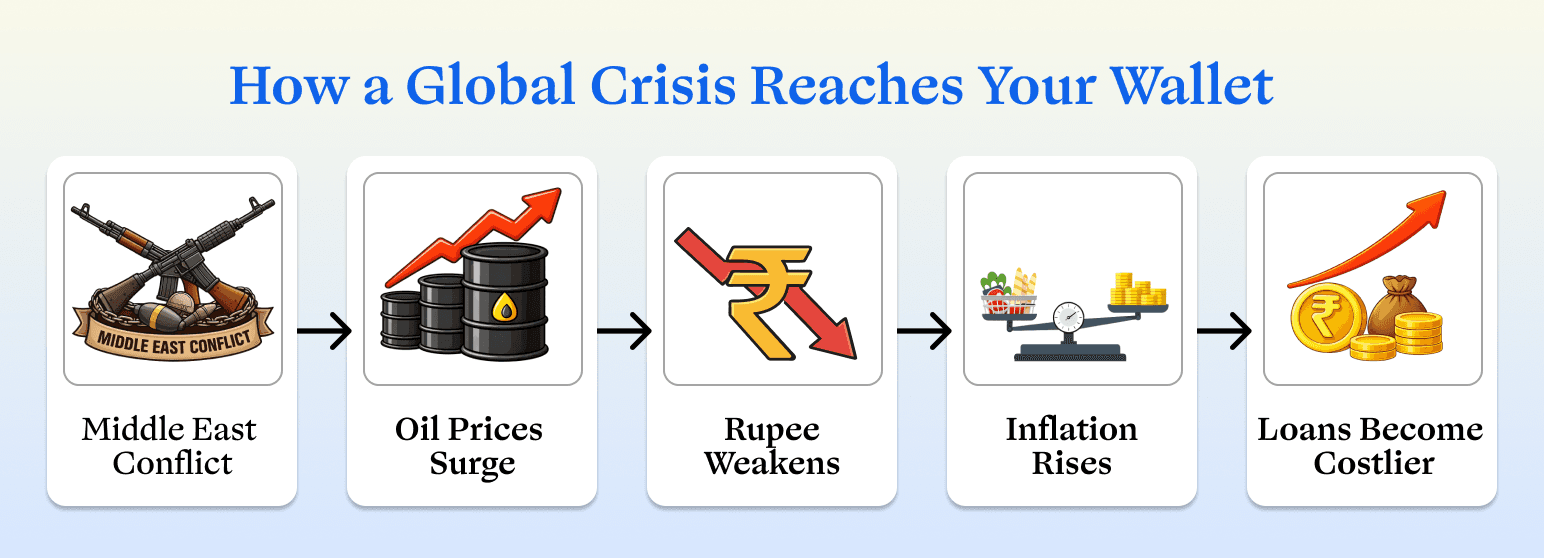
India imports over 85% of its crude oil needs, which means every spike in global oil prices immediately translates into higher demand for dollars.
When geopolitical tensions in West Asia disrupt supply expectations, oil prices tend to rise sharply. In early 2026, prices surged past the $100 mark, pushing India’s import bill significantly higher. And since oil is traded globally in dollars, India needs more dollars to pay for the same quantity of oil.
This increased demand for dollars weakens the rupee. But the currency doesn’t fall in isolation; it pulls other parts of the economy down with it, starting with the cost of everything we import.
A Weaker Rupee and the Rising Cost of Living
A falling rupee makes imports more expensive for fuel, electronics, machinery, even certain food items. Over time, this translates into higher inflation, as businesses pass on rising costs to consumers.
For households, this shows up quietly. Petrol prices inch up. Airfares become more expensive. Imported goods, from smartphones to laptops, cost more than they did a few months ago.
For students planning to study abroad, the impact is even sharper. Tuition fees, living expenses, and currency conversions suddenly become heavier burdens. A weaker rupee doesn’t just change exchange rates; it changes financial decisions.
And as inflation begins to rise, it sets off another chain reaction: one that moves through central banks and financial markets.

Why Inflation Pushes Interest Rates Higher
When inflation rises, central banks like the Reserve Bank of India often step in to control it. One of their primary tools is adjusting interest rates.
Higher interest rates make borrowing more expensive and reduce spending, which helps bring inflation under control. But they also slow down economic activity and increase the cost of loans across the system.
This is where global factors start playing an equally important role, especially decisions made thousands of miles away in the United States.
How US Interest Rates Are Strengthening the Dollar
The Federal Reserve has maintained relatively high interest rates to control inflation in the US. When US interest rates rise, global investors tend to move their money toward American assets, which are seen as safer and more rewarding.
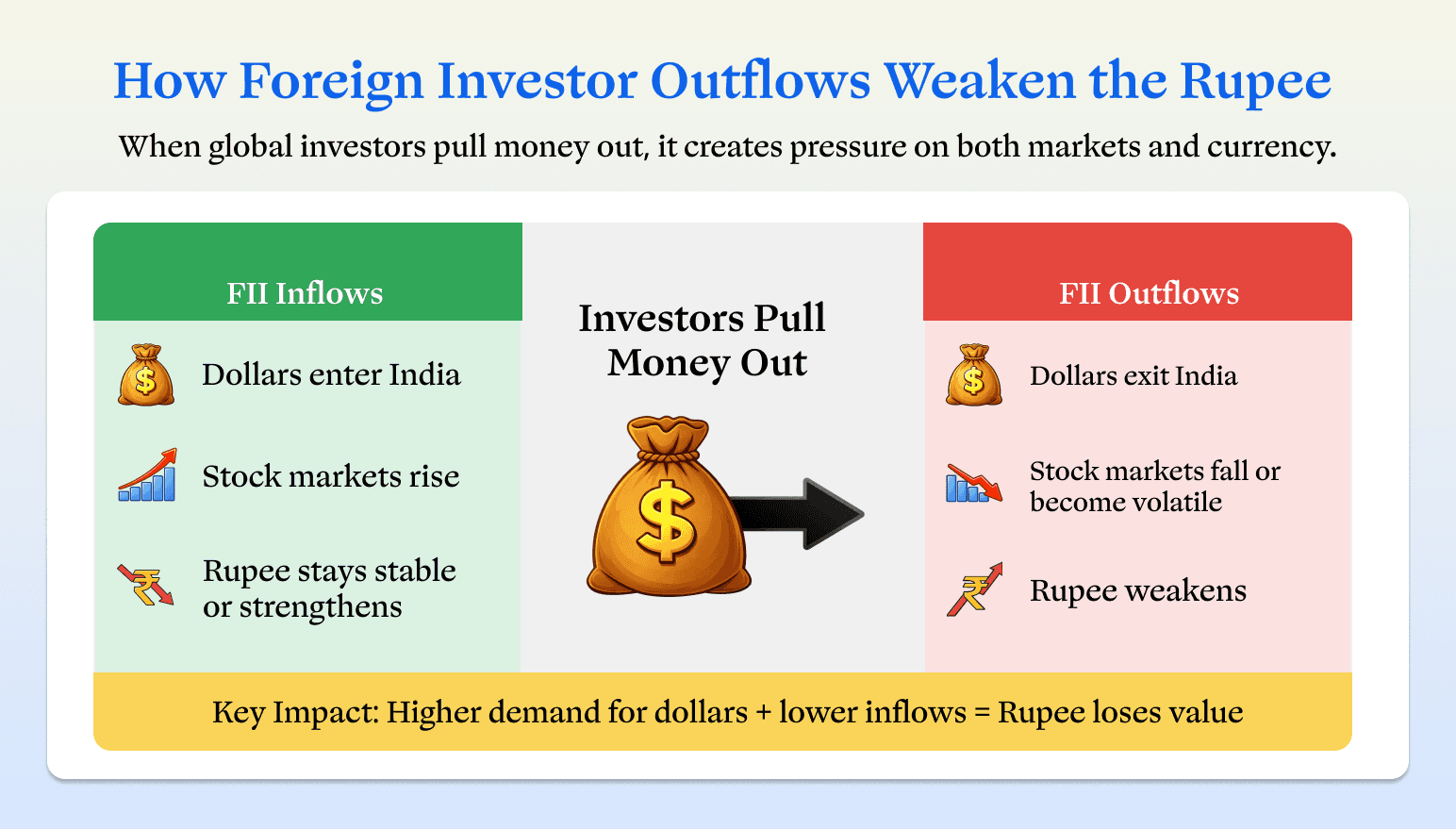
This shift strengthens the US dollar and pulls capital out of emerging markets like India. As foreign investors withdraw funds, the demand for dollars increases further, putting additional pressure on the rupee.
This movement of capital, often referred to as FII outflows, is one of the most important but least understood drivers of currency movements.
FII Outflows and the Pressure on Indian Markets
Foreign Institutional Investors (FIIs) play a significant role in India’s stock and bond markets. When they invest, they bring dollars into the country, supporting the rupee. But when they exit, they convert rupees back into dollars and take that money out.
In periods of global uncertainty like geopolitical tensions or rising US interest rates, FIIs tend to reduce exposure to emerging markets. This leads to capital outflows, stock market volatility, and additional pressure on the currency.
According to data from National Securities Depository Limited, India has seen periods of sustained outflows during global tightening cycles, amplifying currency weakness.
And when multiple pressures such as oil prices, capital outflows, and a strong dollar come together, the rupee doesn’t just fall; it reflects a broader global imbalance.
Geopolitics and the Currency You Use Every Day
The tensions in West Asia are not just political events; they are economic triggers. Any disruption in oil supply routes or production creates uncertainty in global markets.
This uncertainty pushes investors toward safer assets like the US dollar, increases oil prices, and creates volatility in emerging market currencies like the rupee.
In other words, a conflict thousands of miles away can directly influence how much you pay for fuel or how expensive your next purchase becomes. And while this might seem like a new phenomenon, India has seen similar currency pressures before.
What History Tells Us About Falling Rupee Cycles
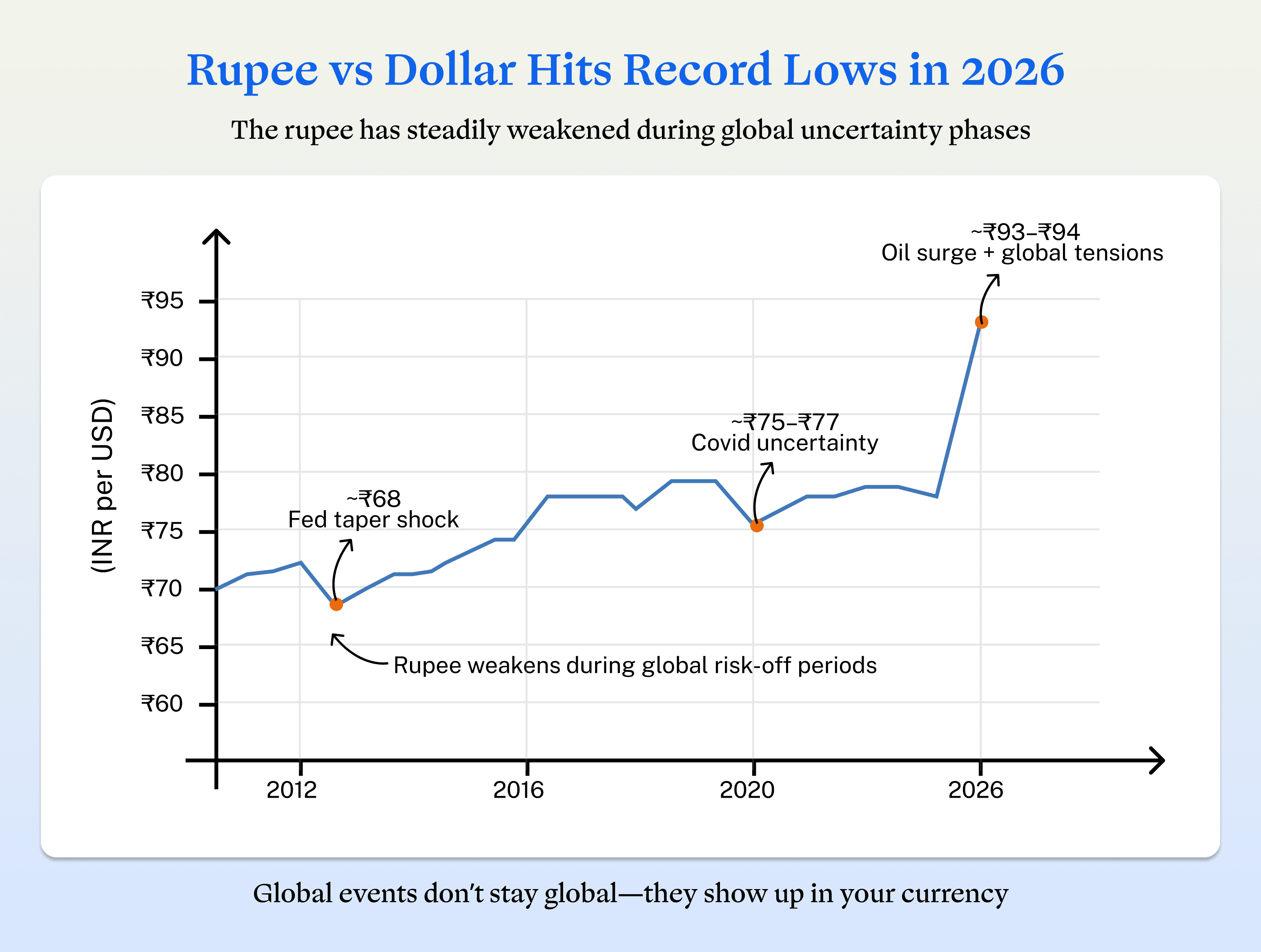
The rupee has faced sharp declines in the past, most notably during the 2013 Taper Tantrum, when global investors pulled money out of emerging markets after signals from the US Federal Reserve.
During that period, the rupee depreciated rapidly, forcing policymakers to take corrective measures. Similar pressures were seen during the 2020 pandemic, when global uncertainty drove capital flows and currency volatility.
These episodes show that currency movements are rarely isolated; they are part of larger global cycles. And understanding these cycles helps make sense of what’s happening today.
Which brings us to the role of India’s central bank in managing these pressures.
How the RBI Responds to a Falling Rupee
The Reserve Bank of India doesn’t control the rupee directly, but it plays a crucial role in managing volatility. One of its key tools is the use of foreign exchange reserves, which stood at over $600 billion in recent years.
By selling dollars and buying rupees, the RBI can stabilise sharp movements in the currency. It can also adjust interest rates or use liquidity measures to manage broader financial conditions.
However, interventions are often about smoothing volatility rather than reversing long-term trends. And that means the real impact is eventually felt where it matters most, i.e., in everyday financial decisions.
Can India Overcome This Fall? The Paths to Rupee Stability
A weakening currency feels like an inevitable slide, but it doesn’t have to be. India has multiple economic levers that can strengthen the rupee over time. These aren’t overnight fixes, but structural pathways.
Here’s what can shift the currency’s trajectory:
Reducing heavy dependence on imported oil
Expanding renewable energy, accelerating EV adoption, and diversifying energy sources can reduce dollar demand over the long term.Strengthening export‑led sectors
IT, pharmaceuticals, electronics manufacturing, and services can expand India’s foreign exchange earnings and create a natural currency buffer.Encouraging steady foreign investment
Predictable policies, lower compliance burdens, and strong capital markets attract stable FDI, reducing volatility caused by FII movements.Building deeper domestic bond markets
A stronger domestic debt ecosystem reduces dependence on global capital cycles.Expanding forex reserves over time
Large reserves act as insurance during global shocks, helping the RBI intervene more effectively.
These are the long-term foundations for a more resilient rupee; not just reactive defenses, but proactive strategies that change India’s vulnerability to global storms.
What a Weak Rupee Means for You
At a macro level, currency movements are about trade balances and capital flows. But at a personal level, they translate into very real consequences.
Higher fuel and transportation costs
Increased prices of imported goods
More expensive education abroad
Potential pressure on job markets in import-dependent sectors
At the same time, some sectors like IT and exports may benefit from a weaker rupee, as their revenues in dollars become more valuable.
So the falling rupee is not just a negative story; it’s a complex shift with both challenges and opportunities. But for most households, the immediate effect is clear: the cost of living rises.
The Bigger Picture Behind ₹94 per Dollar
The rupee crossing ₹94 is not just a number; it’s a reflection of global forces converging at once. Oil prices, US interest rates, capital flows, and geopolitical tensions are all part of the same story.
And while these forces may seem distant, their effects are deeply local. They influence how much you spend, how much you save, and how you plan your financial future.
Understanding this connection doesn’t just explain the news; it helps you make better financial decisions in a world where global events are increasingly personal.

Newly Launched

Pockvue Solutions Private Limited
#1, CRE Spacez, 2nd Floor, 14th Main Road,
Sector 5, HSR Layout, Bengaluru - 560102