
The Hidden AI Tax Making Your Everyday Appliances More Expensive
Imagine you’re a person trying to buy a new mid-range SUV, excited about upgrading to something more reliable for your family. After weeks of saving and researching, you step into the dealership, only to find the price tag is much higher than expected. A vehicle that should have cost $30,000 is now priced at $36,000. Or perhaps you’re a student, eager to get a new laptop for your upcoming semester, but when you look up the model you’ve been eyeing, you’re stunned to see the price has skyrocketed. These price hikes might feel like just another bout of inflation, but there’s a hidden crisis at play; one that’s being driven by a growing shortage of semiconductor chips, exacerbated by the explosive demand for AI-powered chips.
What does this mean for you? Well, the global chip shortage of 2026 is quietly pushing prices higher across all industries, especially in consumer electronics. AI is a major culprit here, and its voracious demand for semiconductors is pulling production capacity away from the chips that power your car, home appliances, and personal tech. Let’s dive deeper into how the AI chip boom is causing this economic crowding out, leaving everyday consumers feeling the financial squeeze.
The Invisible Tug-of-War in the Silicon Forest
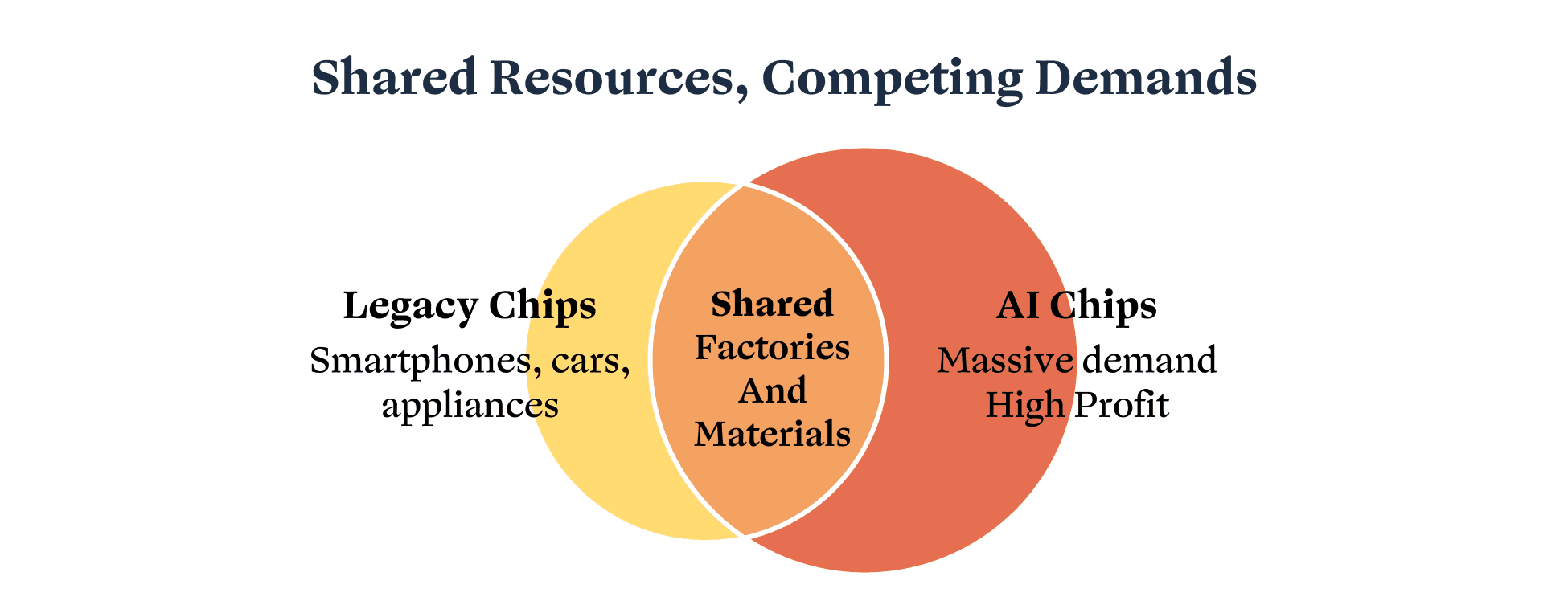
Think of the semiconductor industry as a dense forest, where every tree represents a factory that produces chips. These factories are vast, but still limited in their capacity. The core of the issue today is that AI chips, the specialized components required for AI-driven data centers, are more profitable than the everyday chips that power your car, refrigerator, or phone. While these AI chips and legacy chips are not identical, they share the same raw materials, production facilities, and supply chains.
Manufacturers are now prioritizing the production of AI chips due to their higher profit margins. This has led to a phenomenon known as economic crowding out, where higher-value products (AI chips) push out the production of lower-margin chips, like those used in your consumer electronics. As a result, legacy chips, which are used in essential products like home appliances, cars, and smartphones, are becoming harder to come by, and their production is being severely delayed. These changes are largely invisible to the average consumer, but the impact on prices is clear.
But why is it that AI chips are so much more profitable than the chips used in everyday electronics? Let’s explore the profitability gap between these two types of chips and why the shift in focus is so financially advantageous.
Why Your Toaster is Losing to a Data Center
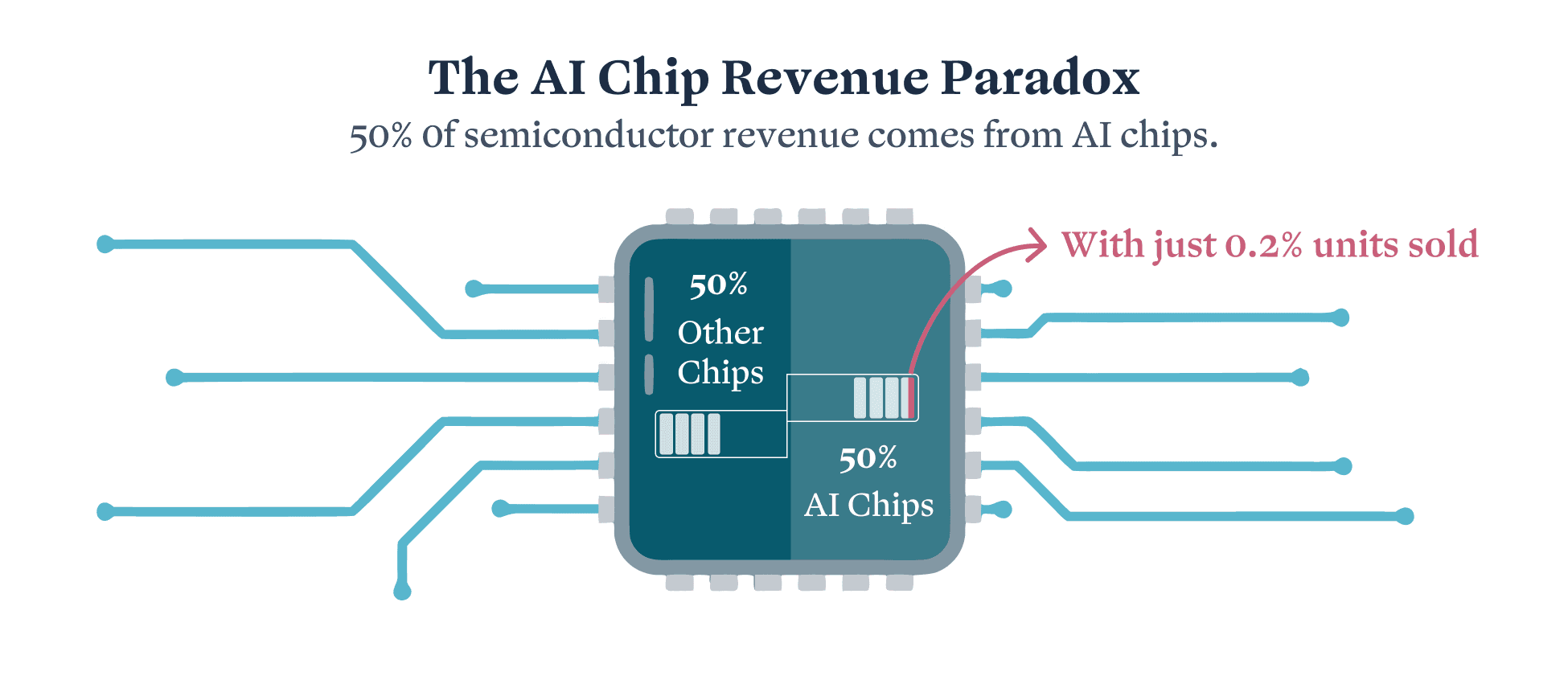
The battle between AI chips and legacy chips is one of profit. AI chips are much more profitable for manufacturers, and this is primarily due to their demand and application in high-end data centers. AI chips, despite making up only 0.2% of unit sales, account for nearly 50% of industry revenue (Deloitte, 2026). Why? Because the price of AI chips is astronomical compared to everyday chips.
In contrast, legacy chips used in consumer products, like your toaster or car, have lower profit margins, even though they make up a larger portion of total unit sales. This disparity in profit margins has led manufacturers to focus their resources on producing AI chips, which offer a better return on investment. The consequence of this shift is clear: the AI chip profitability is leaving the production of consumer electronics behind. The factories that used to focus on your everyday chips are now being repurposed to manufacture AI chips, leaving consumers to face rising prices and delays in their tech purchases.
However, it’s not just the factory floors that are feeling the pinch. The real problem also lies in the memory chips, which play a crucial role in both AI systems and consumer electronics.
The Memory Tax: How AI Eats the World’s RAM
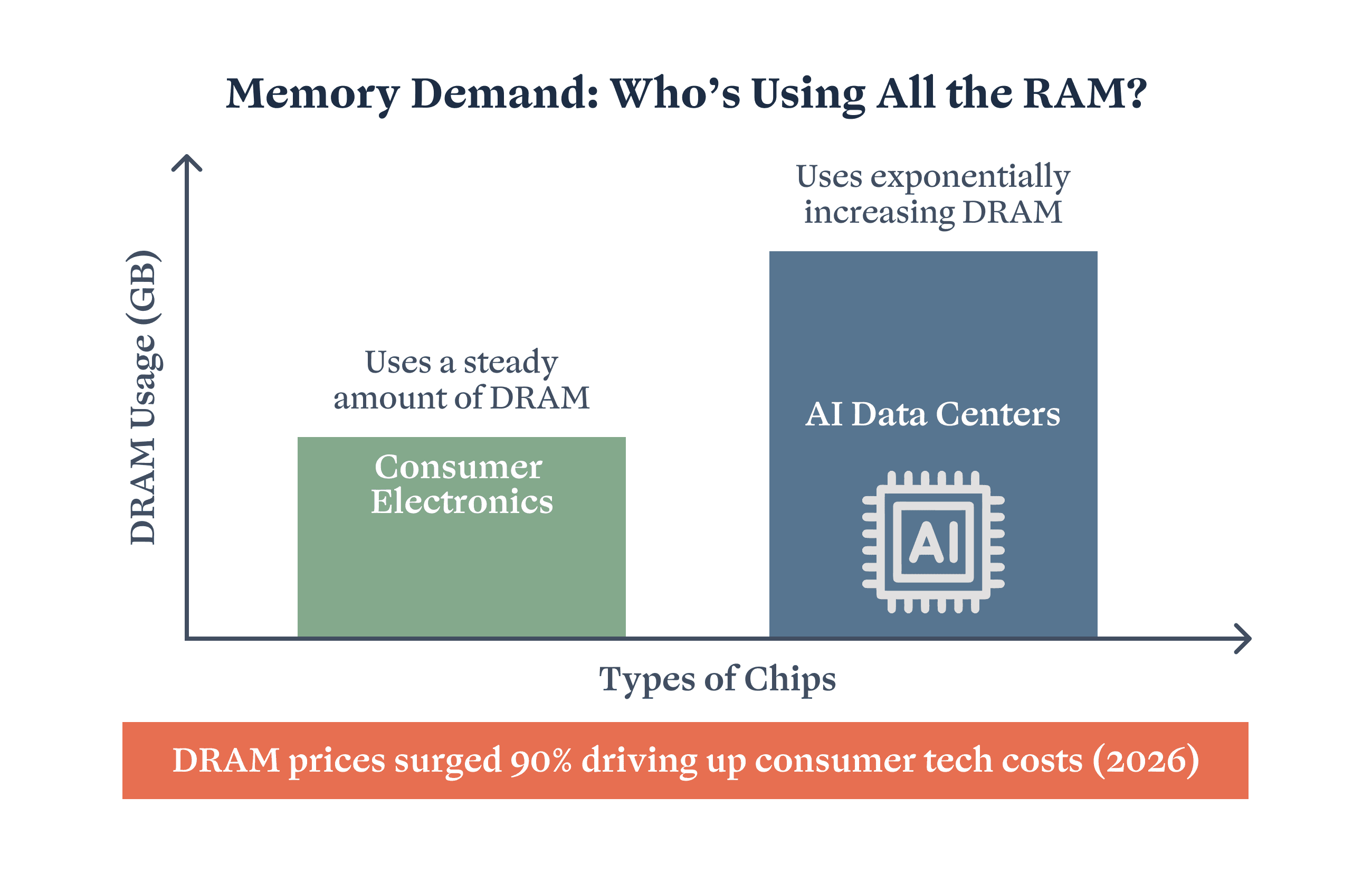
At the heart of the global DRAM and HBM memory shortage lies the rapidly growing demand from AI data centers. Memory chips are critical components in virtually all modern electronics, from smartphones to laptops to automotive systems. However, as AI systems demand more and more processing power, the need for memory has intensified.
As a result, AI data centers are consuming vast amounts of RAM, and this memory tax is driving up prices for everyone. In early 2026, the price of DRAM memory surged by as much as 90%, a massive increase that is pushing up the cost of consumer electronics. These memory chips are vital for everything from personal devices to home appliances, and as AI’s appetite for memory grows, the available supply for consumer products shrinks.
This means that the cost of DRAM and HBM memory is now impacting not only the development of AI systems but also the price of the technology you use every day. As AI gobbles up more memory, it makes your laptop, smartphone, and even your refrigerator more expensive to produce.
But what does this all mean for you, the consumer? The impact of the chip shortage extends far beyond production factories and has started to affect consumers directly.
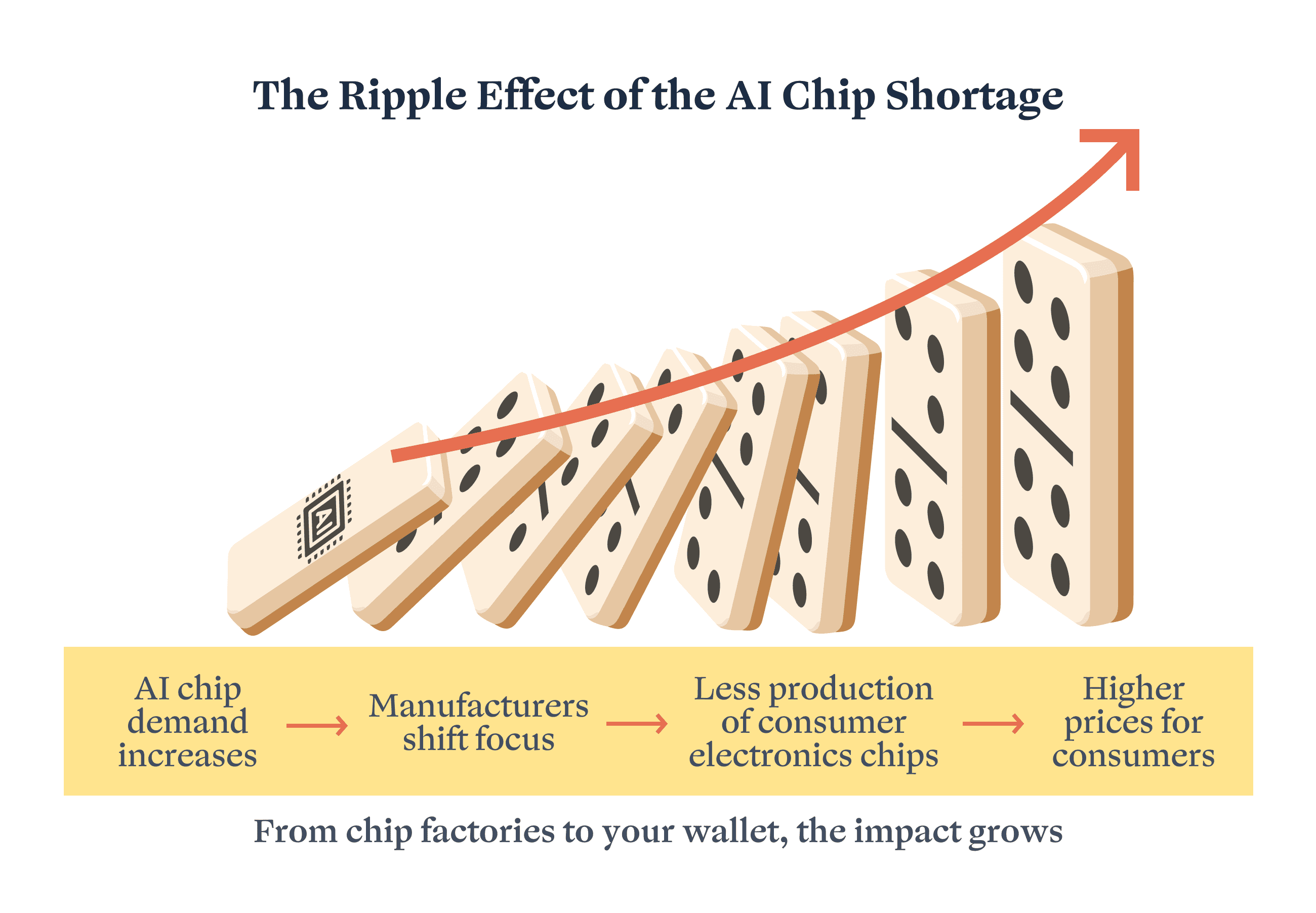
The Domino Effect Flowing From Factory Floors to Your Wallet
The global chip shortage of 2026 is not just a temporary glitch; it’s a chain reaction that starts in the factory and ends in your wallet. The decision by manufacturers to prioritize AI chip production has led to a drastic reduction in the availability of consumer electronics chips, which power products like your car, smartphone, and household appliances. With fewer chips available, the production costs of these everyday products have increased.
This increase in production costs has inevitably been passed down to consumers, who are now paying more for essential items. The price hikes for products like cars, smartphones, laptops, and even refrigerators are part of the domino effect of the semiconductor crisis. The supply chain bottlenecks, combined with the memory crunch, have led to inflation in the consumer electronics market, and this inflation is expected to persist for the foreseeable future.
Consumers are feeling the squeeze as they go to buy everyday items, only to find that the price tags have increased significantly. These price hikes are a direct result of the AI chip boom and the memory tax, which are both pulling valuable resources away from the production of consumer electronics.
With all these factors at play, how can families and students future-proof their finances in this chip-driven world? Let’s explore actionable advice to help you manage the financial impact of this crisis.
Future-Proofing Your Finances in a Chip-Hungry World
As prices for consumer electronics continue to rise due to the AI-driven chip shortage, it’s more important than ever to make informed financial decisions. The good news is that there are several strategies that families and students can use to prepare for the financial impact of the chip shortage.
For parents, it’s crucial to plan for major purchases like cars and home appliances ahead of time. Timing is key. Consider purchasing these items before prices increase further. It’s also wise to explore the option of buying refurbished or older models of electronics, as the prices for new devices are expected to remain elevated. Buying refurbished products can help save money while still providing access to modern technology.
For students, purchasing a laptop or smartphone at the right time is essential. Look for sales events and take advantage of student discounts to get the best deals. Additionally, waiting for new product releases can be a strategic move, as older models may see price reductions when new models hit the market.
Another important tip is to stay informed about financial literacy for families. Understanding how the chip shortage is affecting the prices of everyday products can help you make smarter purchasing decisions. By staying aware of the broader economic shifts, you can better plan your purchases and avoid getting caught off guard by rising prices.


Newly Launched

Pockvue Solutions Private Limited
#1, CRE Spacez, 2nd Floor, 14th Main Road,
Sector 5, HSR Layout, Bengaluru - 560102