The payday paradox behind monthly budget planning with EMI
At 8:04 on a Monday morning, Rohit’s salary notification arrived. He is 39, has two school-going children, a home loan, health insurance, and a plan to save more this year. For a few minutes, the balance looked reassuring.
By lunch, it did not.
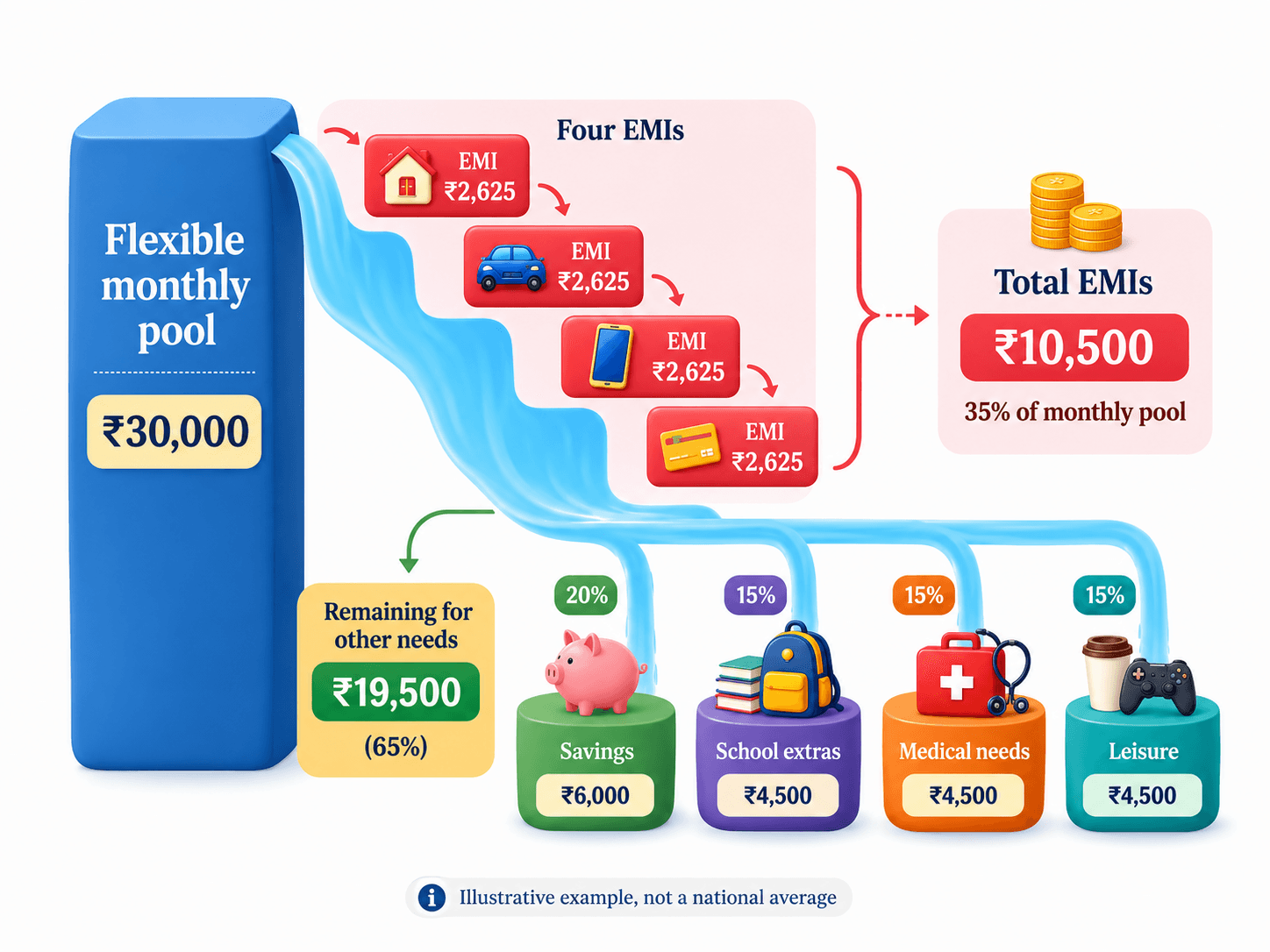
A phone EMI had been debited. Then the tablet bought for schoolwork. Then the smartwatch purchased during a sale. A fourth instalment for headphones was due later that week. None was above ₹3,000. Together, they took ₹10,500 out of the month before groceries, fuel, school expenses, investments, or an emergency could ask for anything.
Suppose Rohit’s household has ₹30,000 left after fixed essentials. Four EMIs totalling ₹10,500 consume 35% of that flexible pool. The problem is that each checkout decision was evaluated alone.
This is where monthly budget planning with EMI becomes less about spreadsheets and more about visibility. An EMI is a claim on future salaries. Judge affordability only by the instalment on screen, and next month can feel crowded before it begins.
Why monthly budget planning with EMI should start before checkout
Add every EMI, subscription, loan payment, and card instalment before approving a new one. Compare that total with money available after essentials and savings. The better question is how much income is already committed.
For families looking to make these money conversations part of everyday learning, the personal finance handbooks help children build a practical understanding of budgeting, saving, spending, credit, and other real-world financial decisions early.
Once the family sees the stack instead of the individual instalment, the next mystery is why “No-Cost” purchases can still create a very real cost.
How four checkout offers expose multiple no cost EMI risks
At checkout, the psychology is powerful. A ₹24,000 gadget feels expensive. “₹2,000 a month” feels manageable. Add three more similar commitments and the household has built a small unsecured-debt portfolio without ever choosing one large loan.
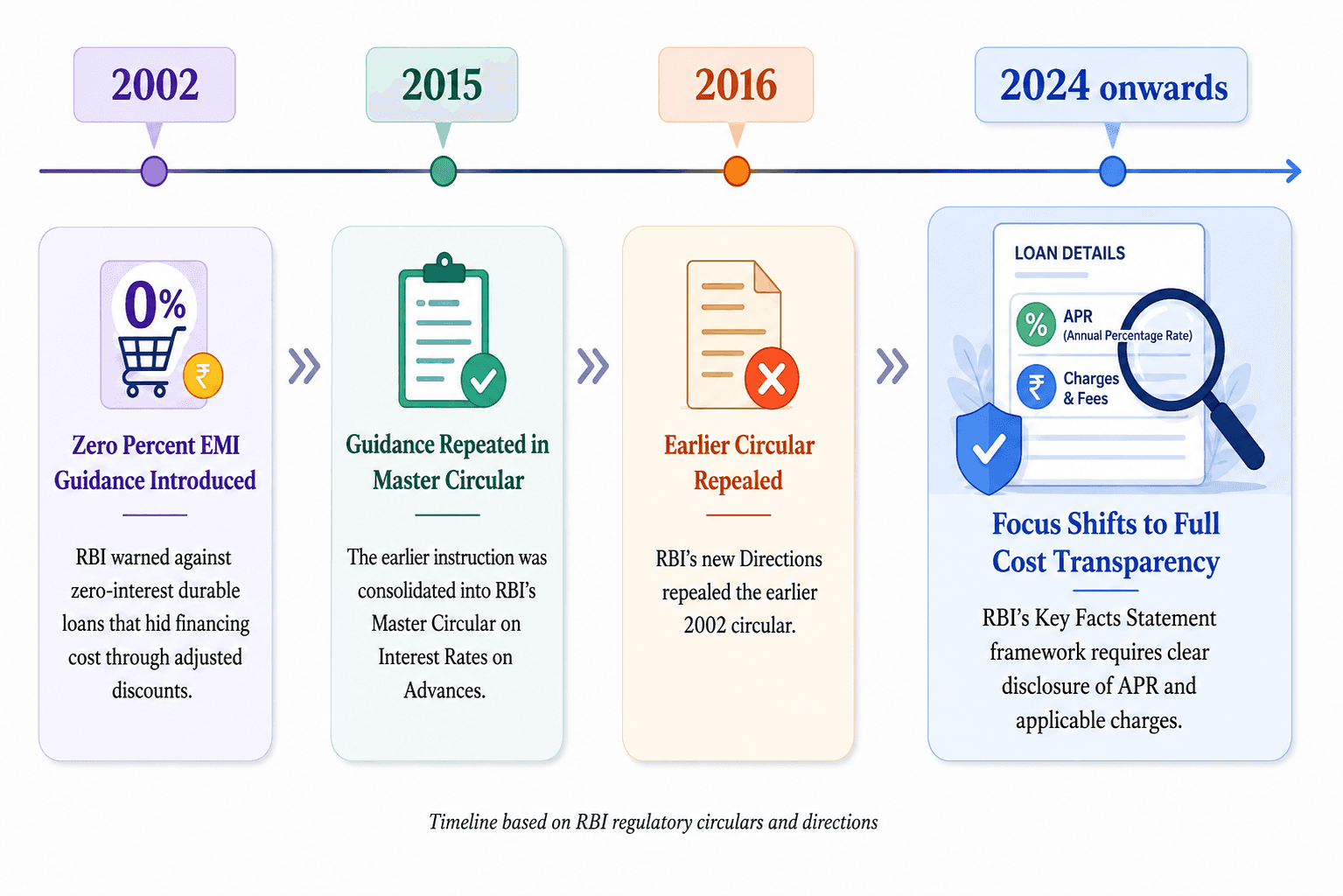
CRIF High Mark explains that a no-cost EMI is not necessarily free of financing economics. In common structures, the buyer may give up a cash discount that effectively covers the interest, or the cost may be embedded in the product price or charges. RBI's more recent consumer-credit rules place strong emphasis on transparency around the true cost of borrowing. Under its Key Facts Statement framework, regulated lenders must disclose the annual percentage rate and key charges associated with a loan, helping borrowers look beyond the EMI displayed at checkout and understand the broader cost of credit.
That distinction matters because multiple no cost EMI risks include lost flexibility, repeated fees, more due dates, reduced card headroom, and the temptation to keep adding commitments.
Good personal debt trap management separates affordability from approval. Bank approval only says credit is available. Before choosing an instalment, compare the EMI price with the best upfront price, identify every fee, and calculate how much of next month’s free cash flow is already committed.
The instalments may be small, but the credit system does not evaluate them only by how harmless they felt at checkout.
The blocked-limit aftershock behind credit utilization ratio in india
A customer may convert a ₹40,000 card transaction into EMI and expect only the first instalment to matter. Yet some issuers block the credit limit up to the EMI principal and restore it gradually as instalments are paid. Canara Bank states this explicitly, and CRIF High Mark notes that the full transaction value can be blocked against the card limit.
Credit-limit blocking and credit-bureau scoring are related, but not identical. A blocked limit does not automatically create a fixed CIBIL-score penalty. CIBIL says payment history, credit utilisation, age of credit, and enquiries influence its score, while higher utilisation can make a borrower appear more credit-dependent.
If reported card balances total ₹45,000 against combined limits of ₹1,00,000, the utilisation ratio is 45%. For households monitoring credit utilization ratio in india, lower is generally better. CRIF High Mark describes below 30% as a commonly recommended range, while CIBIL has also advised cardholders not to exceed 30% of their credit limit. Treat that as a risk-management rule, not a promise of any specific score movement.
The impact of EMI on credit score depends on behaviour. Paying on time supports repayment history. Missing payments can hurt it. High utilisation and repeated credit applications can also matter. One tight month can turn stacked EMIs into missed dues or revolving debt.
And even when every payment is on time, the invoice can still contain costs that rarely appear in the checkout headline.
The layered fee penalty inside multiple no cost EMI risks
Four EMI purchases can mean four processing charges. Depending on the issuer and scheme, fees can start around ₹99 and run to several hundred rupees or more, plus applicable GST.
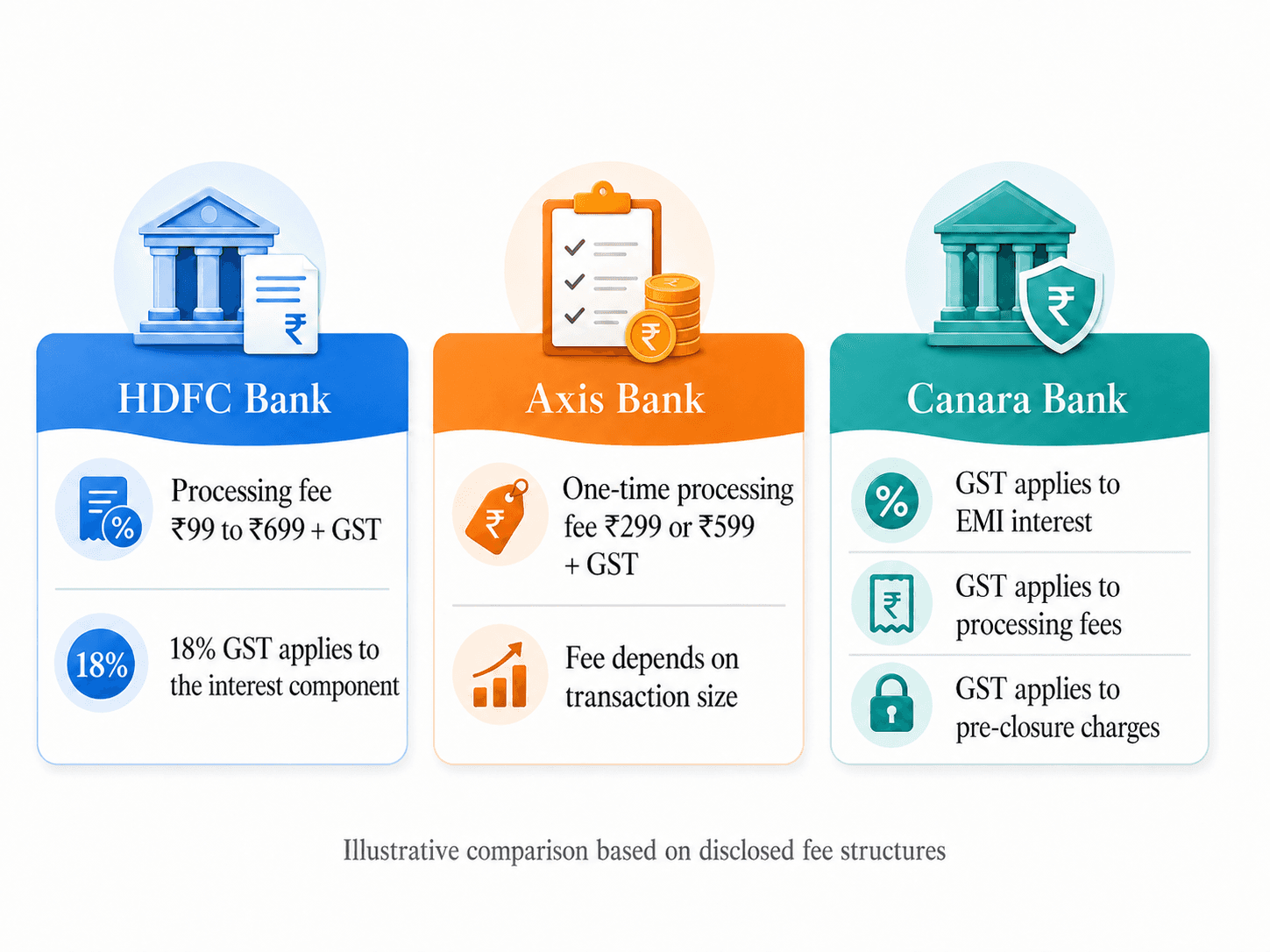
Current bank disclosures show why the fine print matters. HDFC Bank lists processing fees of ₹99 to ₹699 plus GST for EasyEMI and states that 18% GST applies to the interest component. Axis Bank lists one-time processing fees of ₹299 or ₹599 plus GST depending on transaction size. Canara Bank states that GST applies to EMI interest, processing fees, and pre-closure charges.
This is where multiple no cost EMI risks become a cash-flow problem rather than a marketing-label debate.
Why multiple no cost EMI risks become visible only after the invoices add up
For better monthly budget planning with EMI, maintain separate lines for the advertised EMI, processing fee, GST, foregone upfront discount, and any pre-closure charge. Do not assume every no-cost plan has all these costs because structures vary by merchant and issuer.
If four purchases each carry a ₹299 processing fee, that is ₹1,196 before GST on those fees. Repeated friction costs are easy to ignore when purchases are viewed one at a time.
The encouraging part is that an EMI stack can be unwound, but the fastest-looking repayment move is not always the cheapest one.
The step by step reset using how to clear credit card EMI early
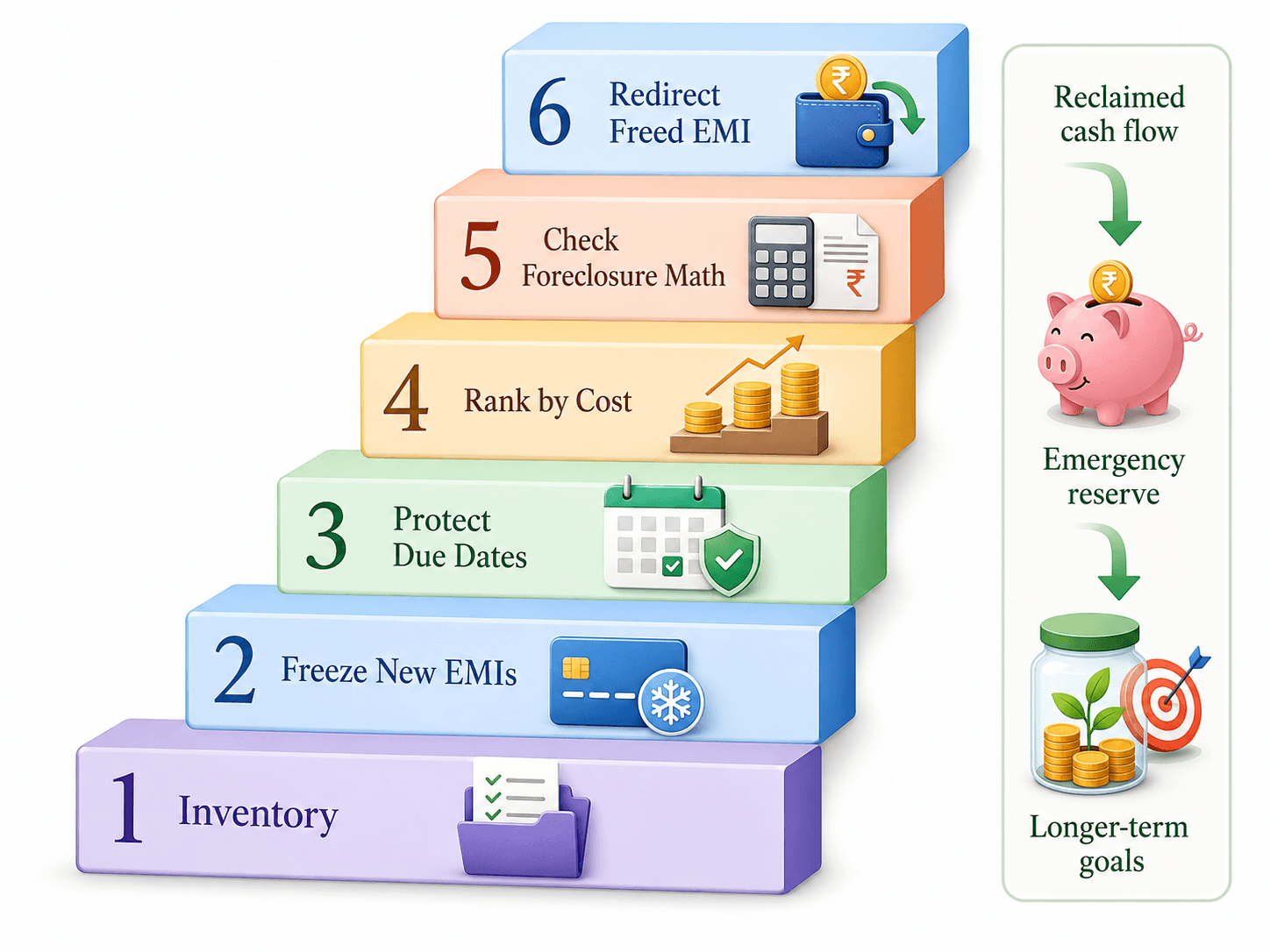
Start with an EMI inventory. Write down every instalment, remaining principal, months left, due date, foreclosure terms, and the lender attached to it. Include consumer-durable loans and buy-now-pay-later obligations. This is the foundation of personal debt trap management because it turns “too many payments” into a finite list.
Next, stop adding new discretionary EMIs for one billing cycle and protect every due date with adequate balance or reminders. A missed payment can damage credit health more than closing one small loan early can help.
Then rank debts using two lenses. First, effective cost. Prioritise expensive revolving card balances or high-cost debt. Second, cash-flow release. If two obligations have similar costs, clearing a small EMI that frees ₹2,500 every month can create breathing room quickly.
The closure calculation behind how to clear credit card EMI early
Anyone searching how to clear credit card EMI early should check the issuer’s foreclosure rules before paying. Some banks levy pre-closure charges plus GST. Federal Bank lists a 3% foreclosure charge plus GST on remaining principal for its credit-card EMI facility, while Canara Bank lists a 2% pre-closure fee.
Call the issuer, request the exact closure amount, and compare it with the remaining scheduled cost. If prepayment still makes sense, close the EMI and redirect the freed monthly amount rather than absorbing it into lifestyle spending.
Finally, build a starter emergency buffer, keep card utilisation low, review your credit report for errors, and avoid unnecessary fresh applications while balances fall. Those habits support the impact of EMI on credit score without pretending there is a shortcut.
For parents who want their children to put financial concepts into practice and test their understanding, they can also explore the National Finance Olympiad.
With the action plan clear, the final safeguard is simple. Before saying yes to another “small” EMI, look at the promises your future salary is already carrying.

Newly Launched

Pockvue Solutions Private Limited
#1, CRE Spacez, 2nd Floor, 14th Main Road,
Sector 5, HSR Layout, Bengaluru - 560102