Have you noticed how naturally UPI has become part of your daily routine? A quick scan at the neighbourhood grocery store. Your child's school fees, once paid after waiting in a queue, now cleared in seconds from your phone. Even a portion of your hospital bills, settled with a simple tap at the payment counter. For millions of Indians, UPI is no longer just another payment method. It has become a familiar part of everyday household life.
So, when a video appears in your family WhatsApp group or pops up on your Instagram feed claiming that UPI transactions above ₹2,000 will no longer be free, a little concern is understandable. Does this mean every large payment will now come with an additional charge? Will you need to reconsider how you pay your regular bills?
Before you let those claims worry you, there is an important detail worth understanding. The reality is quite different from what these messages suggest, particularly for consumers.
From October 15, 2026, the new framework introduces a Merchant Discount Rate (MDR) of 0.4% on specified Person-to-Merchant UPI transactions above ₹2,000. The MDR is a merchant-side payment acceptance charge. It is not a blanket fee deducted from every consumer who spends more than ₹2,000. Person-to-person transfers remain free regardless of the amount.
That distinction matters because the phrase "UPI charge above ₹2,000" can easily make it sound as though sending ₹3,000 automatically costs the sender extra money.
In reality, it does not!
If you send ₹5,000 to a family member through a normal P2P (Person-to-Person) UPI transfer, the new MDR does not apply. When you scan a merchant’s QR code, any applicable MDR is a fee the business pays for accepting your UPI payment. It is a merchant-side cost, not an extra charge that should be added to your bill or deducted from your bank account.
Payments of ₹2,000 or less continue without MDR, and the FAQ of the National Payments Corporation of India (NPCI) says these transactions account for more than 95% of UPI merchant-payment volume. Small merchants within the eligible P2PM (Person-to-Person-Merchant) category receiving up to ₹1 lakh per month through UPI QR collections also continue with zero MDR.
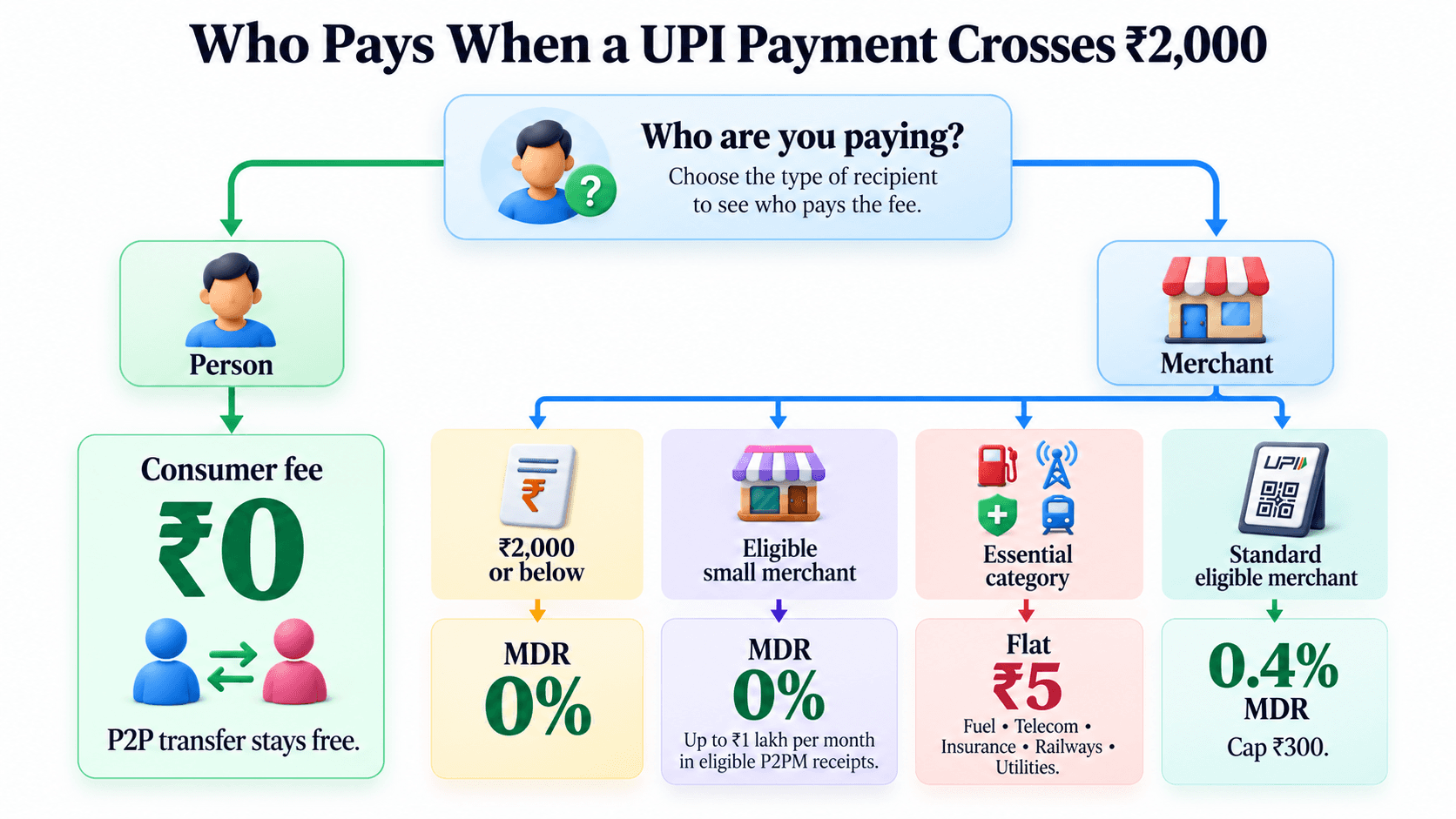
The ₹2,000 number therefore matters, but understanding who is receiving your money matters even more. And that brings us to what MDR actually means.
Understanding Merchant Discount Rate vs UPI consumer fees without banking jargon
Merchant Discount Rate sounds like the kind of banking term most families can safely ignore. But the easiest way to understand Merchant Discount Rate vs UPI consumer fees is to think about the card machine at a restaurant.
When a business accepts a digital payment, several pieces of infrastructure help that payment move securely from your account to the merchant. Banks, payment-system participants, technology providers, fraud-prevention systems, and settlement infrastructure all play a role.
MDR is essentially a cost associated with the merchant accepting that digital payment.
Under the new rules, eligible merchant payments above ₹2,000 may attract a 0.4% MDR. For example, the merchant pays ₹12 on a ₹3,000 transaction and ₹200 on a ₹50,000 transaction. The maximum charge is ₹300, even for payments above ₹75,000. This fee is borne by the merchant, not the customer.
The consumer, meanwhile, pays the listed purchase amount.
There is another term families may encounter called interchange revenue sharing. In simple terms, imagine several organisations helping deliver a parcel. One collects it, another transports it, and another completes the final delivery. The fee earned from providing the overall service may be distributed among participants according to the payment network's rules.
The same broad principle applies inside digital-payment infrastructure. MDR revenue is not simply a government tax collected each time you scan a QR code. NPCI's FAQ says MDR revenue supports technology, cybersecurity, fraud prevention, innovation, and payment-system operations.
This is also why P2P and P2M should never be treated as interchangeable terms.
P2P means Person-to-Person. Think sending money to your spouse, reimbursing a friend, or transferring money to a relative.
P2M means Person-to-Merchant. Think paying a supermarket, restaurant, online retailer, school, petrol pump, or other commercial establishment.
The new 0.4% framework targets specified P2M transactions above the threshold rather than ordinary P2P transfers.
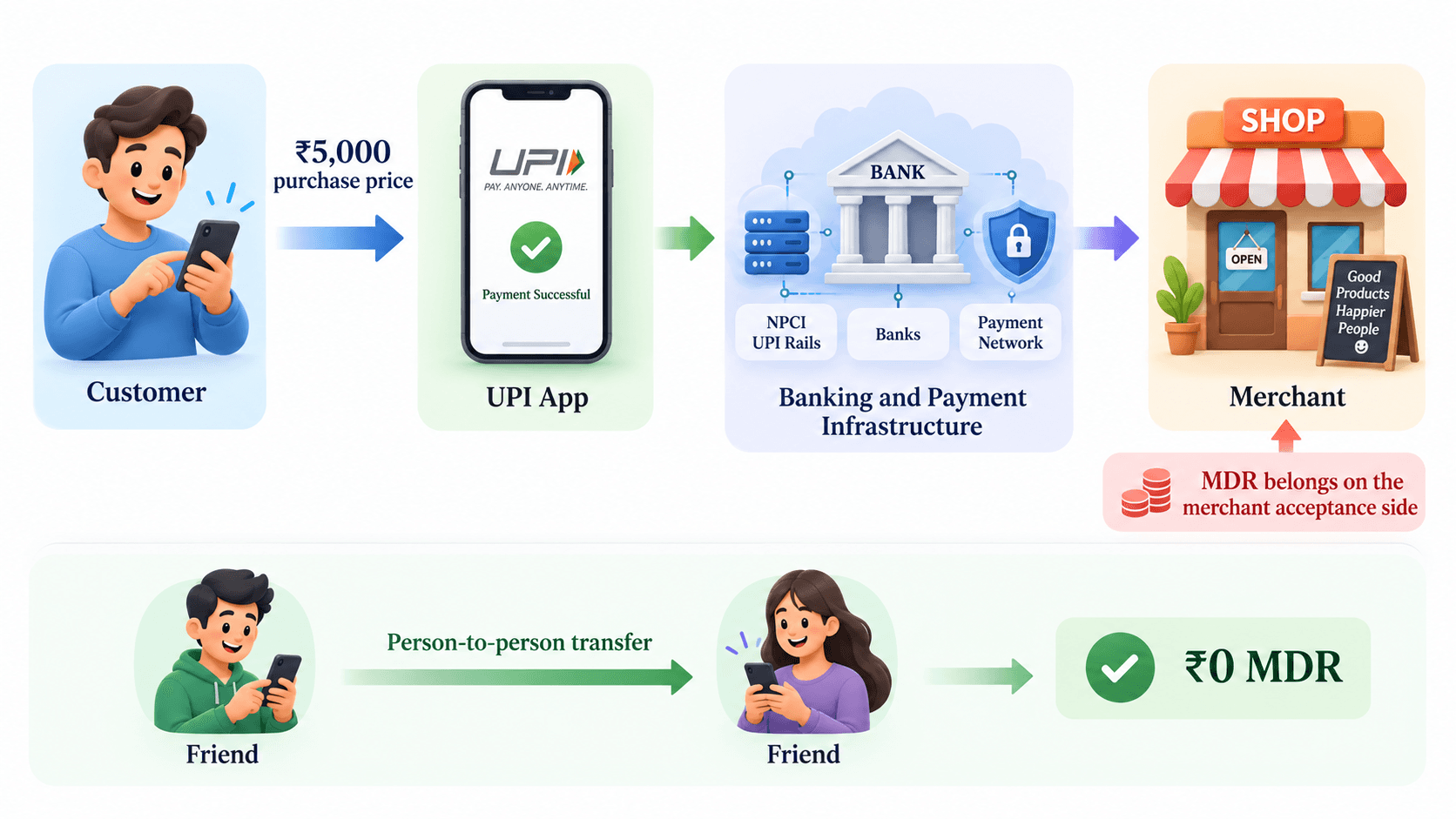
Once that distinction is clear, the next question becomes much more practical- what happens when the payment is something families cannot easily avoid, such as school fees, fuel, insurance, or electricity?
How UPI rules for education and utility bills protect essential family spending
Household budgets are not just restaurant meals and online shopping. They include so much more!
A ₹3,500 electricity payment, ₹8,000 insurance premium, ₹4,000 fuel bill accumulated through commercial transactions, or a much larger school-fee payment can easily cross ₹2,000. That is why the UPI rules for education and utility bills deserve special attention.
NPCI's FAQ describes concessional treatment for essential and sensitive categories rather than automatically applying the ordinary 0.4% rate across every sector.
For railways, telecom services, insurance, fuel, utilities, and other notified categories, the applicable merchant-side MDR is a flat ₹5 per transaction above ₹2,000.
Educational institutions, including schools, colleges, universities, and examination bodies, receive concessional or capped MDR structures for payments above ₹2,000. Transactions up to ₹2,000 remain MDR-free.
That wording is important. It would be misleading to tell parents that every tuition payment above ₹2,000 carries the normal 0.4% rate.
Capital-market payments receive separate treatment too. Payments involving mutual funds, securities, stockbrokers, dealers, and investment platforms are covered by a concessional MDR of 0.02%, capped at ₹300.
Recurring payments are another useful distinction. Reporting on the framework states that UPI mandates and auto-debits are exempt rather than being treated like ordinary chargeable merchant payments each time they execute.
The policy therefore works more like a collection of lanes than one blanket toll booth.
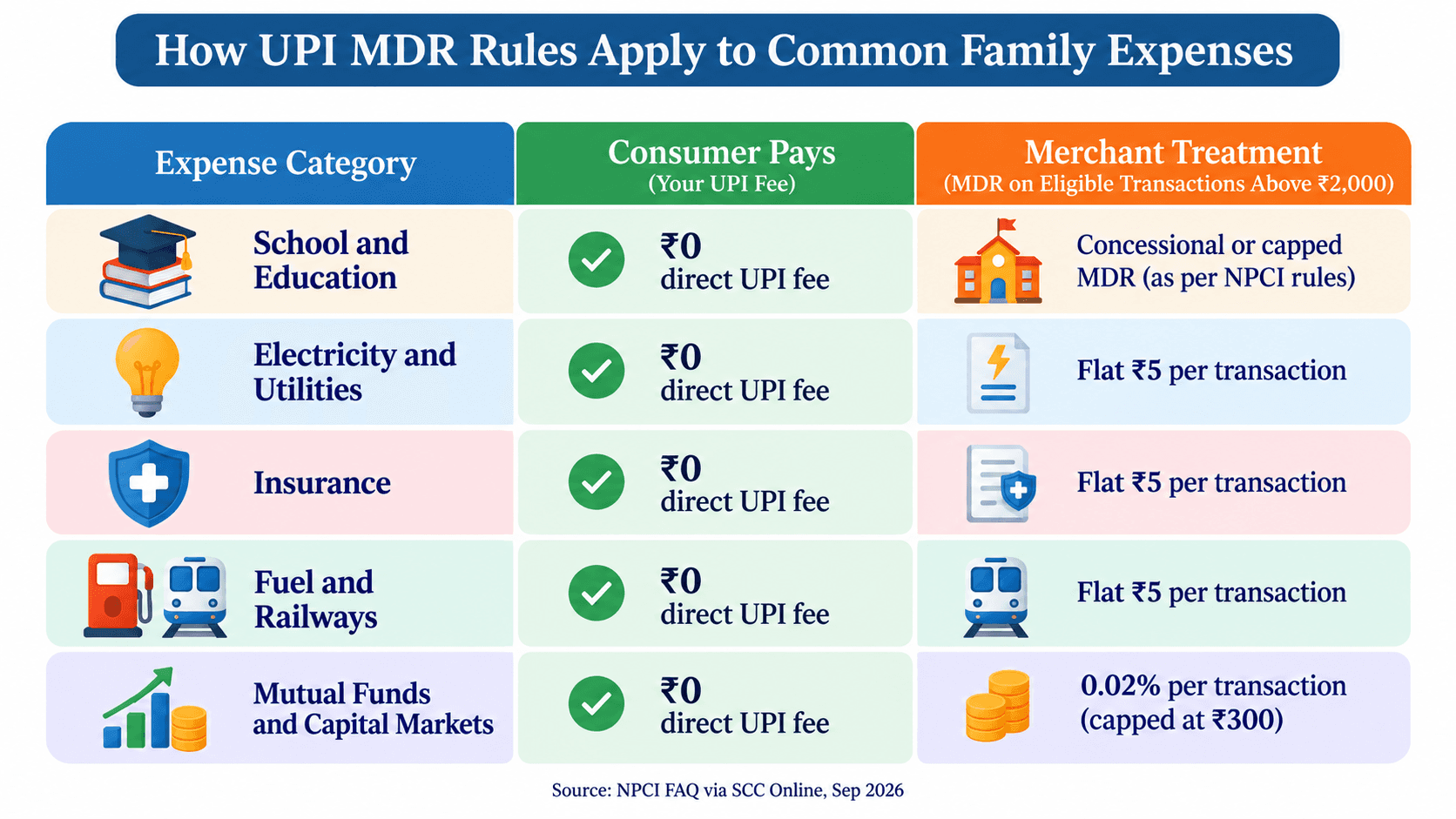
Knowing the category protects you from misunderstanding the rule, but knowing your consumer rights protects you when somebody tries to turn a merchant cost into your cost.
Knowing how to avoid extra UPI charges when a merchant asks for more
Picture this: your bill is ₹3,000. You scan. The cashier says, “UPI over ₹2,000 costs extra now.” Do you pay?
No you don’t pay, at least without understanding how to avoid extra UPI charges! Do not assume that a merchant's MDR can automatically be added to your bill.
NPCI's FAQ says merchants are not permitted to pass the MDR charge on to customers, and UPI application providers are expressly prohibited from imposing platform fees or similar charges on ordinary UPI transactions covered by the framework. That gives families a practical checklist.
First, check whether the extra amount is actually appearing inside the UPI transaction or whether the merchant is manually increasing the invoice.
Second, ask what the additional charge represents. A genuine separately disclosed service fee associated with an unrelated service is different from simply relabelling MDR as a "UPI fee".
Third, keep the invoice, payment confirmation, UPI transaction reference number, and screenshots if a disputed digital-payment charge appears.
For problems involving a UPI transaction, NPCI says consumers can raise grievances through participating banks' UPI apps. NPCI also operates a complaint-registration mechanism that routes eligible transaction complaints to the relevant bank or institution.
If the issue concerns deficiency in service by an RBI-regulated entity and remains unresolved through the appropriate first-level complaint process, RBI's grievance-redress framework provides an additional escalation route. RBI's Integrated Ombudsman Scheme was updated with effect from July 1, 2026.
The goal is not to argue over every billing counter. It is to know the difference between a legitimate purchase amount and a payment-system cost that the merchant has been told not to pass through.
That knowledge becomes even more useful when families organise UPI as part of the monthly budget rather than treating every scan as an isolated transaction.
Managing UPI charges for high-value transactions through a smarter household payment system
Good budgeting is not about avoiding digital payments. It is about choosing the right payment method for the right job.
Start by separating routine spending from high-value commitments.
Small everyday purchases such as snacks, local transport, or minor household spending can be placed into a dedicated spending bucket. UPI Lite can be useful for eligible low-value purchases because it is designed to make frequent small payments convenient without mixing every tiny expense into your mental picture of major household commitments.
For larger obligations, keep a monthly list of school fees, utilities, insurance, investments, rent, and other scheduled payments.
Understanding UPI charges for high-value transactions helps you distinguish between a consumer fee and the commercial cost on the merchant side. Do not split a legitimate ₹6,000 purchase into three ₹2,000 payments merely because you have heard that ₹2,000 is a charging threshold. The threshold concerns MDR treatment and does not mean you personally owe a 0.4% surcharge above it.
Use recurring UPI mandates or authorised auto-debits for predictable bills when the provider supports them. They can reduce missed-payment risk and make monthly cash-flow planning easier. Current reporting on the October framework states that UPI mandates and auto-debits remain outside the new MDR charge.
For direct transfers to people, normal P2P UPI remains free under the framework.
Keep one further safety habit. Before approving any large payment, verify the recipient name displayed in the app, check the amount twice, and never share your UPI PIN. NPCI states that a UPI PIN is used to authorise bank transactions and should not be shared with anyone.
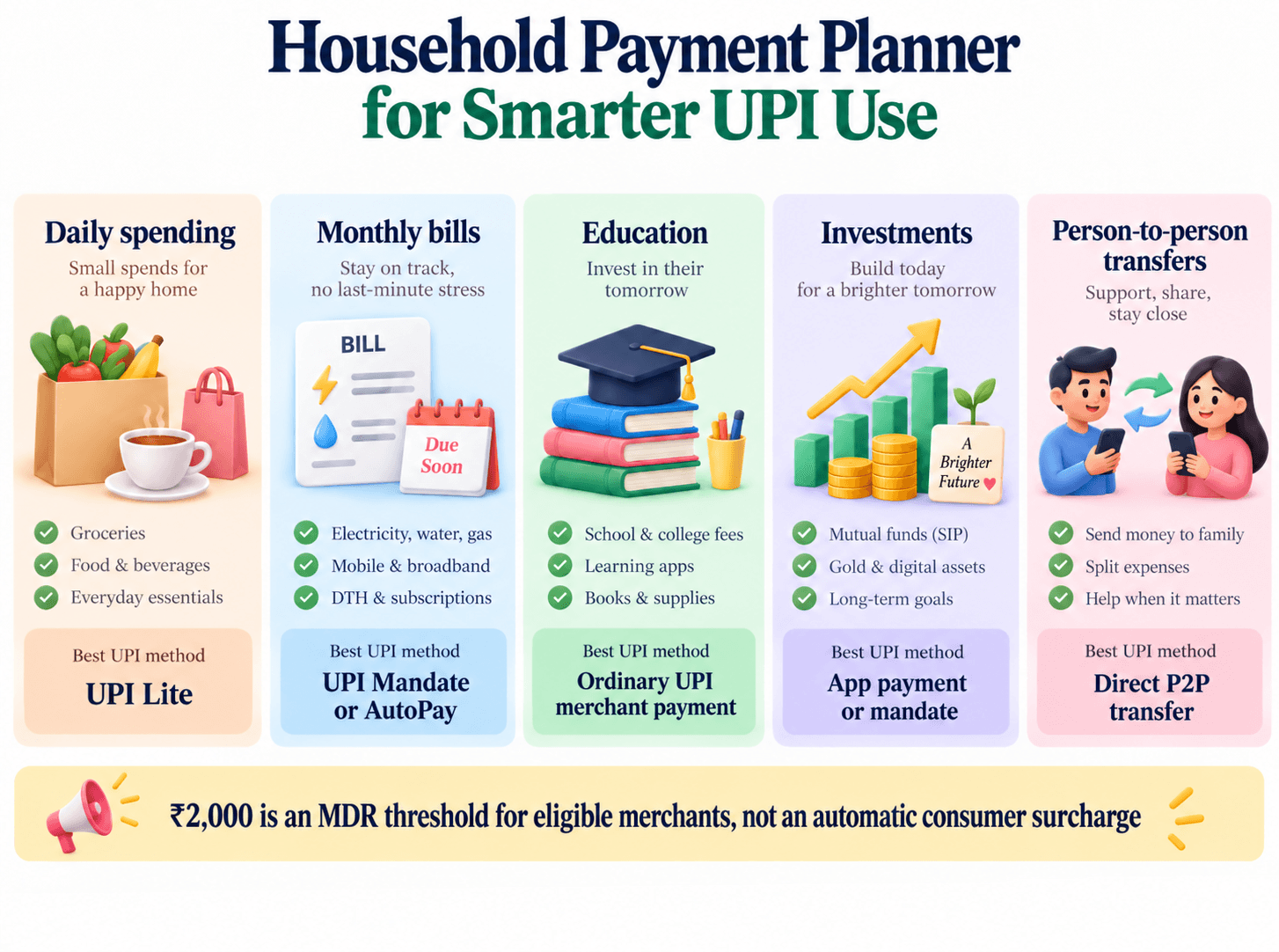
Understanding which payments remain free, where merchant charges apply, and how to choose the right UPI method can help you manage your everyday expenses with greater confidence, without worrying about unexpected charges every time you make a payment.

Newly Launched

Pockvue Solutions Private Limited
#1, CRE Spacez, 2nd Floor, 14th Main Road,
Sector 5, HSR Layout, Bengaluru - 560102