A parent pulls i
nto an Indian Oil outlet in Delhi after a long school pickup run, sees E85 priced at ₹82.12 per litre beside regular E20 petrol at ₹102.12 per litre, and feels the kind of relief only a household fuel bill can create.
The reaction is understandable. Fuel is not an abstract economic number for Indian families. It is the cost of office travel, school drops, coaching class rounds, grocery runs, hospital visits, weekend plans, and the occasional trip that begins with the sentence “let us just drive”. So when a new fuel appears with nearly a ₹20 per litre discount, the first instinct is obvious. It looks like savings.
But fuel is not used by the litre. It is used by the kilometre. That is where the real story of the E85 fuel running cost in India begins.
The new fuel station mirage
Delhi’s E85 launch has created a powerful price board moment. At ₹82.12 per litre, E85 looks meaningfully cheaper than E20 petrol at ₹102.12 per litre. On a 40-litre refill, the visible difference can look close to ₹800.
That number feels real because it is immediate. You see it before you pay. You can multiply it in your head. You can imagine it staying inside the monthly budget.
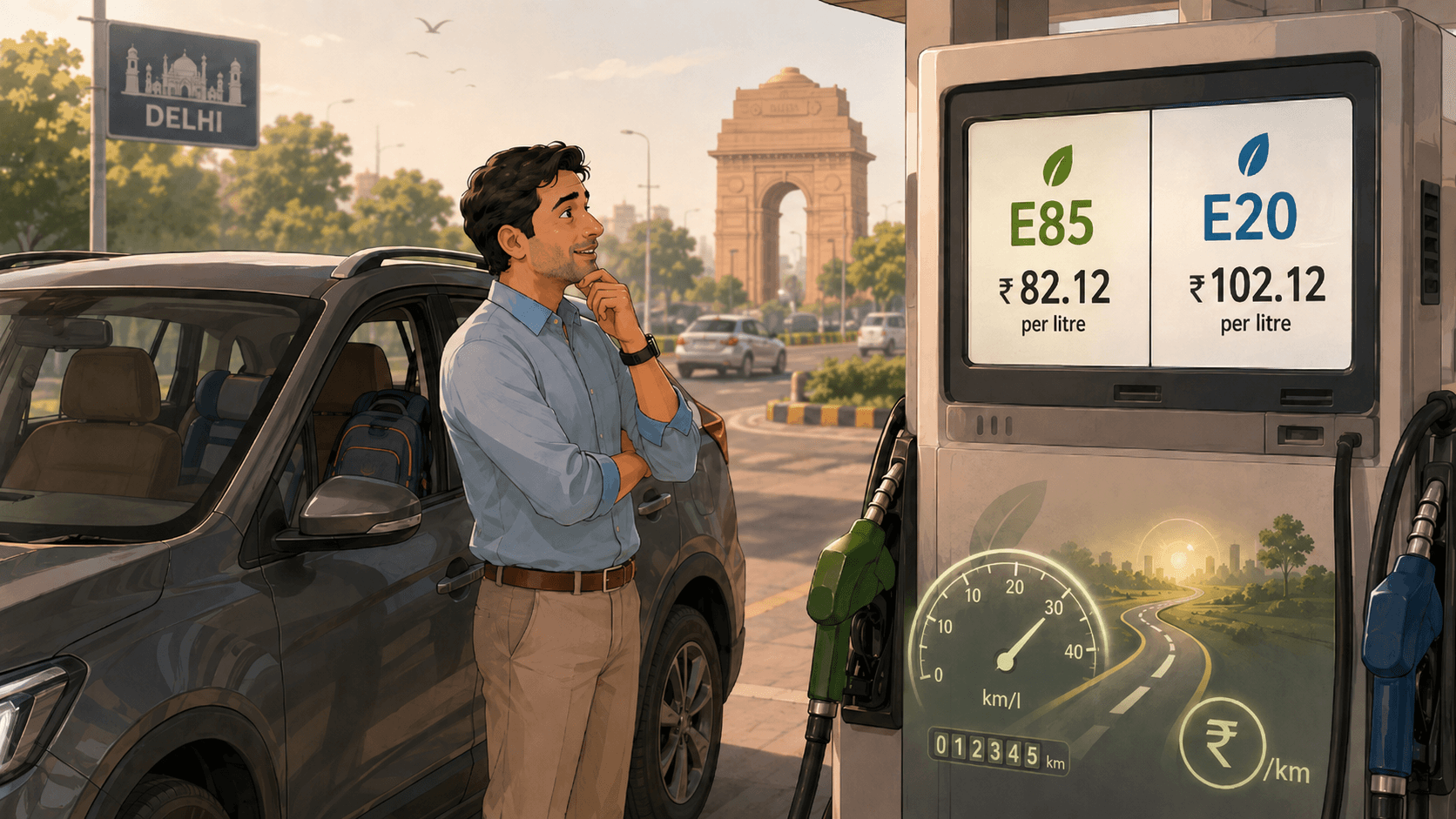
The problem is that the pump only shows the price per litre. It does not show how far that litre will take your vehicle. That missing distance is the difference between cheap fuel and cheaper travel.
Why a litre of E85 does less work
Energy density sounds like a classroom term, but it is easy to understand.
Think of a thin candle and a thick wood log. Both burn. Both produce heat. But they do not keep the flame alive for the same duration. Petrol and ethanol behave similarly inside an engine. Both can move a vehicle, but they do not carry the same energy punch per litre.
E85 is a high-ethanol fuel blend. It has much more ethanol than the E20 petrol, which is now commonly used as the baseline blend. Ethanol has lower energy content than petrol, which means an engine may need more litres of an ethanol-heavy blend to cover the same distance.
This is not a flaw in the fuel. It is a property of the fuel. That is why the ethanol mileage drop calculation becomes the most important number for a family. If mileage falls by 25% to 30%, the cheaper pump price may not translate into a cheaper journey.
Once that energy gap enters the picture, the only fair comparison is no longer price per litre, but cost per kilometre.
The kitchen table calculation
Let us take a simple family car example.
Assume the car gives 15 kmpl on E20 petrol. At ₹102.12 per litre, the petrol running cost becomes ₹6.81 per kilometre. Now, place E85 at ₹82.12 per litre into the same household calculation.
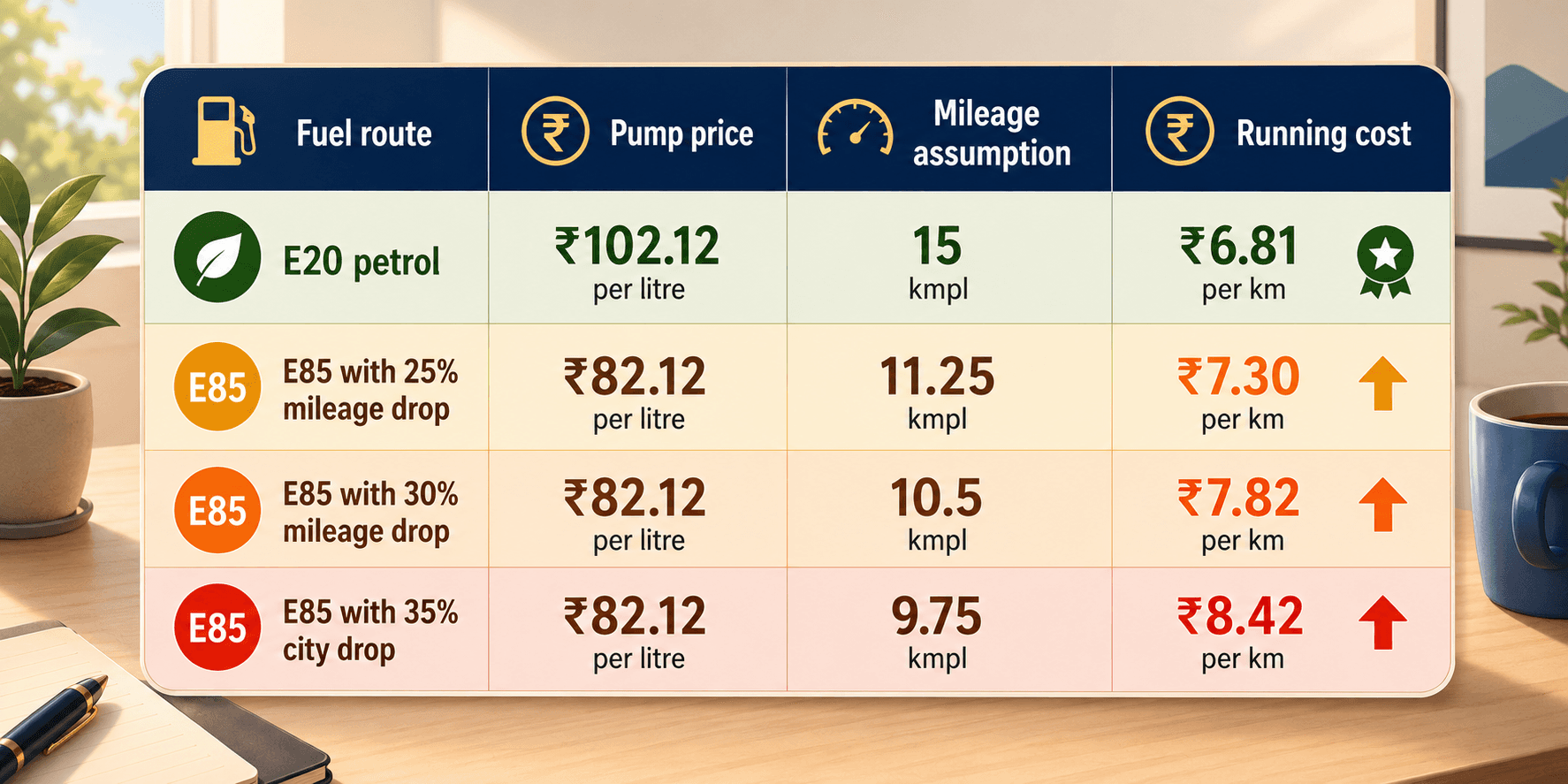
You can make the following table as an infographic:
Fuel route | Pump price | Mileage assumption | Running cost |
E20 petrol | ₹102.12 per litre | 15 kmpl | ₹6.81 per km |
E85 with 25% mileage drop | ₹82.12 per litre | 11.25 kmpl | ₹7.30 per km |
E85 with 30% mileage drop | ₹82.12 per litre | 10.5 kmpl | ₹7.82 per km |
E85 with 35% city drop | ₹82.12 per litre | 9.75 kmpl | ₹8.42 per km |
This is the cost per kilometre fuel calculation that matters.
At the pump, E85 looks cheaper. On the road, it can become costlier. With a 25% mileage drop, the running cost rises by about 7%. With a 30% mileage drop, it rises by about 15%. In dense city driving, where idling, air conditioning, short trips, and stop-start traffic punish mileage, the gap can move higher.
The ₹20 discount is visible. The extra fuel consumption is hidden. The table reveals the surprise, but the more useful question is even sharper: at what mileage does E85 actually break even?
The break-even number families should know
The easiest way to judge E85 is to calculate the mileage it must deliver to match petrol.
In our example, petrol costs ₹6.81 per km. For E85 at ₹82.12 to match that same running cost, the vehicle must deliver about 12.06 kmpl. That is the break-even point.
If your E85 mileage is above 12.06 kmpl, there may be savings. If it falls below 12.06 kmpl, the lower pump price is not enough. You are spending more per kilometre.
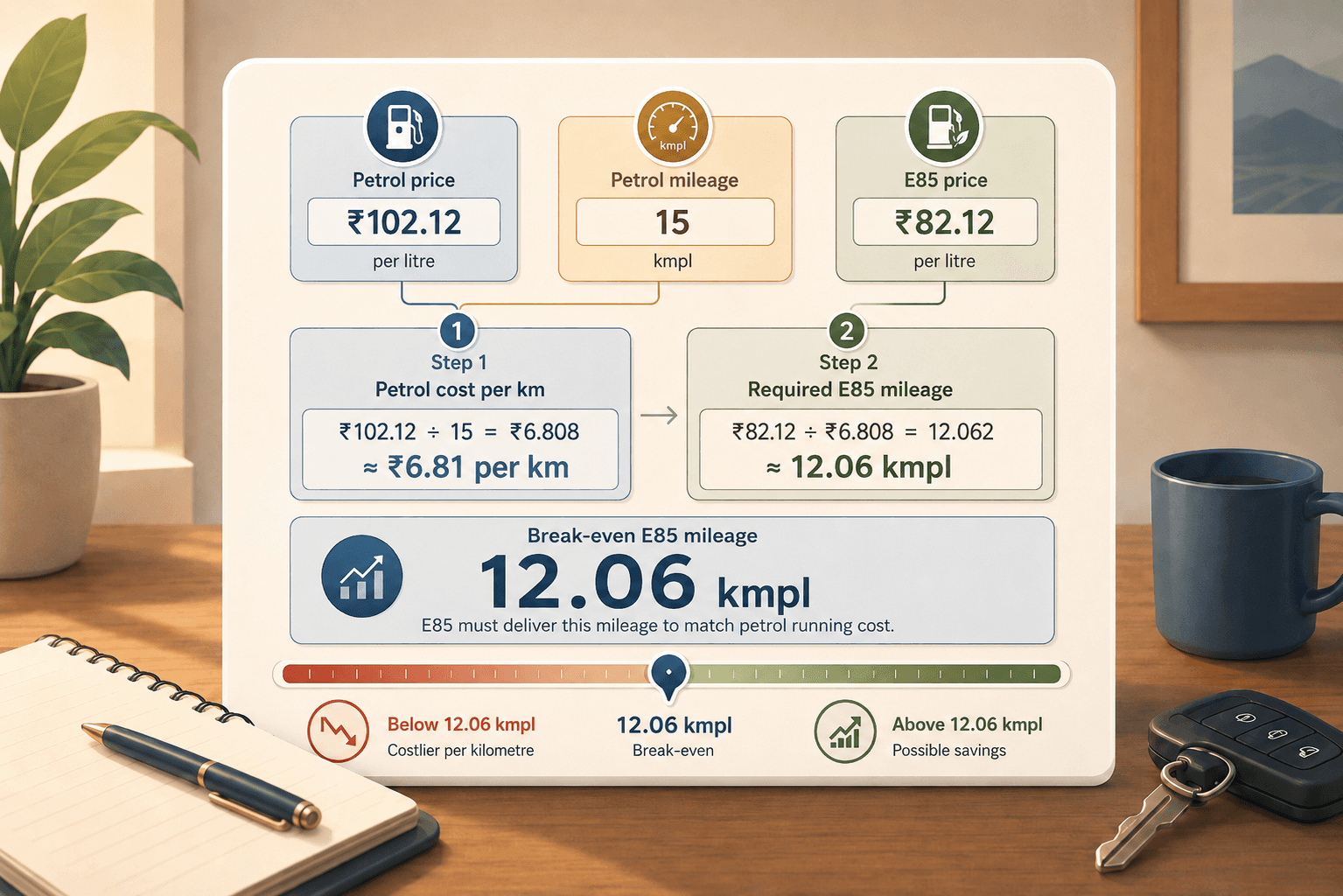
This is why a cheaper alternative to petrol in Delhi cannot be judged only by the price board. It has to be judged by the distance it buys.
The real comparison is not ₹82.12 versus ₹102.12. The real comparison is ₹7.30 per km versus ₹6.81 per km.
The compatibility warning that matters more than price
There is a bigger issue than the running cost. E85 is not meant for every vehicle.
E20-ready does not mean E85-ready. E20 petrol has 20% ethanol. E85 has a much higher ethanol share. That jump changes what the fuel system must handle.
A flex-fuel vehicle needs suitable fuel lines, seals, tanks, injectors, sensors, and engine calibration. Ethanol can absorb moisture and can affect parts that are not designed for high ethanol blends. In a vehicle not built for E85, the damage may not announce itself immediately. The vehicle may start. It may run. It may even feel normal in the beginning.
But the fuel system can still be under stress. That is why the first household rule is simple. Do not use E85 unless the vehicle is clearly certified for it.
Check the owner’s manual. Check the fuel cap marking. Check official manufacturer communication. Ask the dealership. If the answer is unclear, do not experiment.
A ₹20 per litre saving is meaningless if it creates a repair bill.
The new vehicle cost question
E85 makes financial sense only when the vehicle is designed for it. That brings in another layer of family budgeting.
A flex-fuel vehicle may cost more than a regular petrol version because it needs different engineering. In two-wheelers, the premium can be relatively small. In cars, the additional engineering cost can be larger because the fuel system and engine management need more changes. This is where the flex fuel vehicle price premium becomes part of the same calculation.
Imagine a family buying a new vehicle mainly because E85 looks cheaper. The question is not only whether E85 is available nearby. The question is whether the extra vehicle cost can be recovered through real running cost savings.
If E85 does not reduce the cost per kilometre, the payback may be weak. If fuel pricing changes later and the gap becomes wider, the calculation may improve. If the family drives heavily every month, the payback may be faster. If the vehicle is used occasionally, the benefit may take much longer.
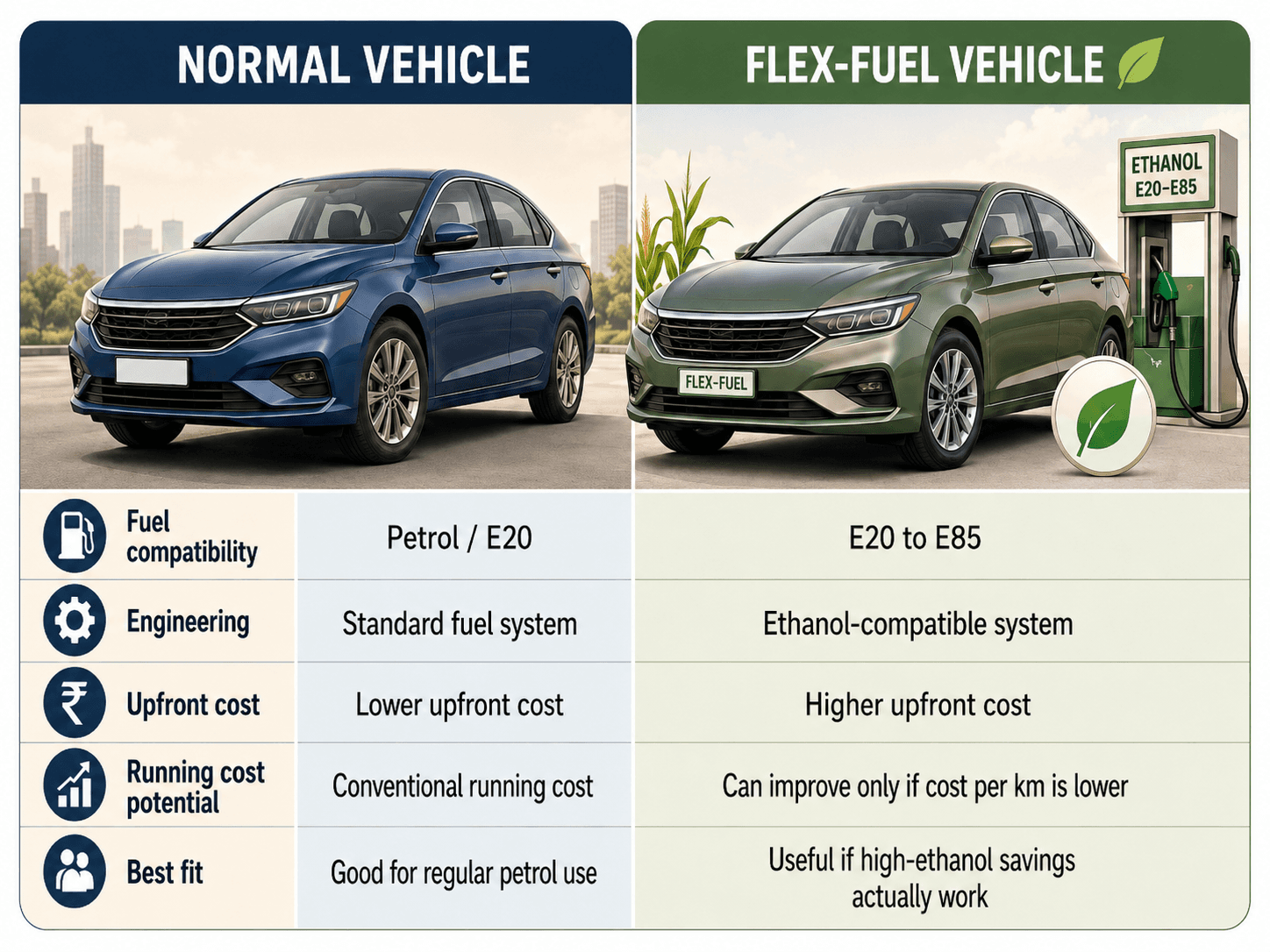
This is where the fuel decision becomes less about headlines and more about how often the family actually drives.
What this does to a monthly fuel bill
Let us convert the same math into a household budget.
For 1,000 km of monthly driving, petrol at ₹6.81 per km costs about ₹6,810. E85 at ₹7.30 per km costs about ₹7,300. E85 at ₹7.82 per km costs about ₹7,820.
That means the household may spend ₹490 to ₹1,010 more per month even after choosing the fuel that looked cheaper at the pump. Over a year, that becomes ₹5,880 to ₹12,120.
That is not a small difference. It can pay for an annual vehicle service, a school activity, a health check-up, or a meaningful addition to a savings goal.
This is why E85 should not be treated only as auto news. It is a household finance decision. And the numbers make one thing clear: E85 can only be called cheaper after it passes three household checks.
The final verdict for Indian families
E85 is not a scam. It is not a miracle either. It is a new fuel route whose value depends on three checks.
First, your vehicle must be genuinely E85 compatible.
Second, your real mileage drop must be low enough to preserve savings.
Third, the price gap must be wide enough to beat the extra consumption.
In Delhi’s current example, ₹82.12 per litre looks attractive against E20 petrol at ₹102.12 per litre. But for a 15 kmpl car, E85 needs to deliver about 12.06 kmpl to break even. If mileage falls to 11.25 kmpl or 10.5 kmpl, the cheaper litre becomes a costlier kilometre.
So before filling up, ask the better question. Not “What is the price per litre?” Ask “What is my real cost per kilometre?”
That is the family budget test for India’s new E85 fuel.

Newly Launched

Pockvue Solutions Private Limited
#1, CRE Spacez, 2nd Floor, 14th Main Road,
Sector 5, HSR Layout, Bengaluru - 560102