The annual school payment page opens, and for a few seconds the amount seems familiar. Then memory begins adding what the screen does not show.
The transport renewal. The books ordered separately. The uniforms that no longer fit. The activity fee in a circular. The device repair. The coaching expense that never appears on the school invoice but has quietly joined the family routine.
This is how the cost of education in India often reveals itself. Not as one dramatic demand, but as several ordinary payments that slowly gather weight.
Parents rarely question these expenses because education represents possibility and the hope that a child will have more choices than the generation before.
But when every expense feels necessary, one question is easily missed. How much is education truly taking from the household each year? That answer begins with the costs that never appear together.
The growing multiplier inside hidden school expenses
Most families know the annual tuition figure. Far fewer know the complete annual education figure. That gap is where hidden school expenses accumulate.
The school may collect course fees, but the household also pays for books, transport, uniforms, activities, devices, subscriptions and coaching. The problem is that each cost is evaluated separately.
A ₹4,000 uniform purchase in April may feel unrelated to a ₹12,000 transport instalment in June. The bank account still experiences both as one annual commitment.
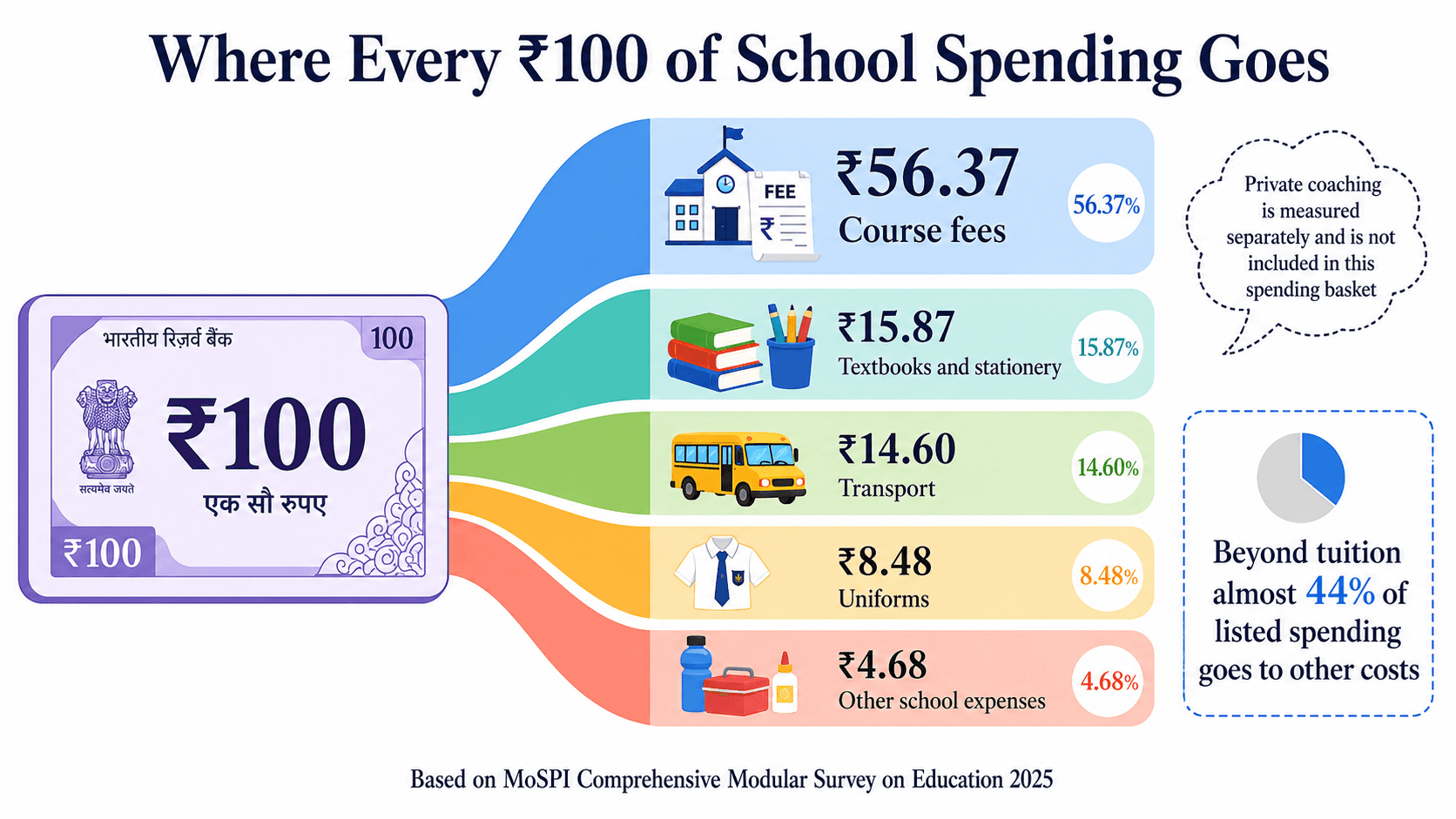
MoSPI’s Comprehensive Modular Survey on Education 2025 shows why looking beyond tuition matters. Across all school types, the average spending per student on course fees was ₹7,111. Textbooks and stationery added ₹2,002, transport ₹1,842, uniforms ₹1,070 and other expenses ₹590. Private coaching was measured separately, so a family’s complete education outflow may be higher than the school-expenditure figure alone.
The first financial mistake is therefore not always spending too much. It is measuring too little. And once the complete bill is visible, the next surprise is how relentlessly it has been climbing.
The salary race against the cost of education in India
Salary growth rarely moves in a straight line.
Some years bring a strong appraisal. Others bring little or no increase. Meanwhile, housing, healthcare and everyday living absorb part of the gain before it reaches long-term savings. Education costs follow a different rhythm.
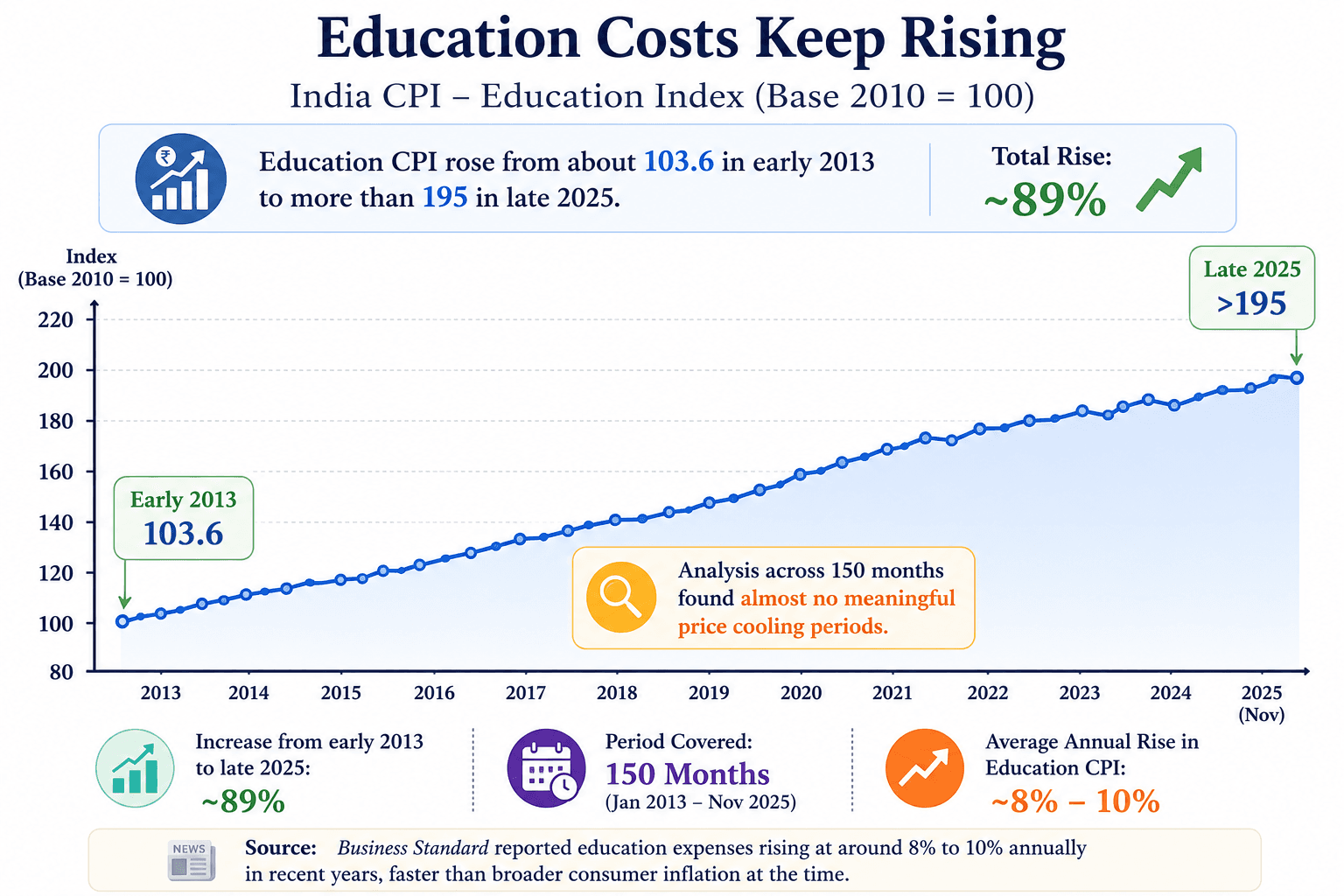
India’s education component within the Consumer Price Index rose from about 103.6 in early 2013 to more than 195 by late 2025. That is an increase of nearly 89%. Across 150 months, the analysis found almost no meaningful price cooling.
Imagine your salary taking the stairs while education stands on an escalator that keeps moving even during a weak appraisal cycle.
This is why the cost of education in India can feel heavier even when parents earn more. The question is not whether income increased. It is whether income increased faster than the complete education bill.
Business Standard reported that education expenses had been rising at around 8% to 10% annually in recent years, faster than broader consumer inflation at the time.
A cost that rarely falls does not merely affect this year’s budget. But to understand why the pressure feels so different across families, we have to look at where their children study.
The widening divide behind private school fees
National averages cannot describe every family, but they reveal the pressure.
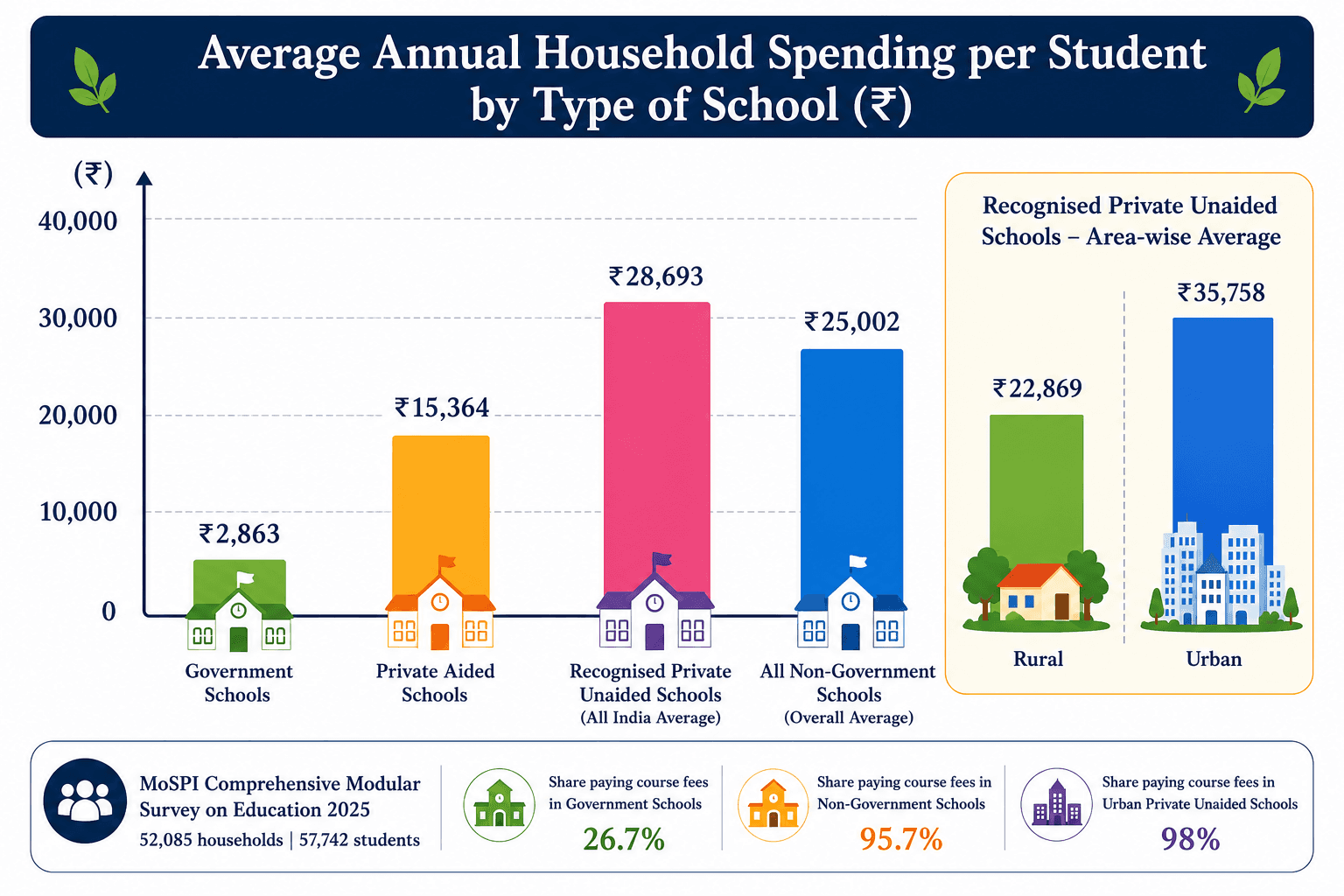
The MoSPI survey covered 52,085 households and 57,742 students. Average annual household spending per student was ₹2,863 in government schools and ₹25,002 across non-government schools.
The detailed report separates the non-government category further. Average expenditure was ₹15,364 in private aided schools and ₹28,693 in recognised private unaided schools. In urban areas, the private unaided average rose to ₹35,758, compared with ₹22,869 in rural areas. This distinction matters. ₹25,002 is the combined non-government average, while ₹28,693 is the national average for recognised private unaided schools.
For parents paying private school fees, even these figures may appear low. A metro family with multiple children, transport, activities and coaching can spend far more. An average is therefore a map of the system, not a ceiling for an individual household.
The survey also found that 26.7% of government-school students reported paying course fees, compared with 95.7% in non-government schools. In urban private unaided schools, the share reached 98%.
The divide is not only between school systems. It is also between the fee families expect and the full cost their choices eventually create.
The household pressure behind annual household income spent on education
A school fee can be large and still be affordable. It can also appear manageable while quietly weakening every other financial goal. The difference lies in proportion.
The most revealing number is the share of annual household income spent on education after tuition, transport, books, uniforms, coaching and related costs are added.
A 2026 Down To Earth analysis, citing the Great Indian Wallet Study 2025, noted that families may spend 20% to 30% of annual household income on education once ancillary costs are included.
The exact share will differ. A debt-free dual-income family may cope better than one paying a home loan, supporting ageing parents and rebuilding emergency savings. That is why annual household income spent on education is not a judgement score. It is a stress indicator.
If the percentage rises while retirement contributions and emergency savings remain stagnant, the family may be financing education by quietly borrowing from other goals. And that is the point where a school expense becomes a family financial strategy question.
The protection plan for the rising cost of education in India
The goal is not to reduce every education expense.
Parents may choose a school, activity or coaching programme because they see value in it. A strong plan respects those choices without weakening retirement or emergency security.
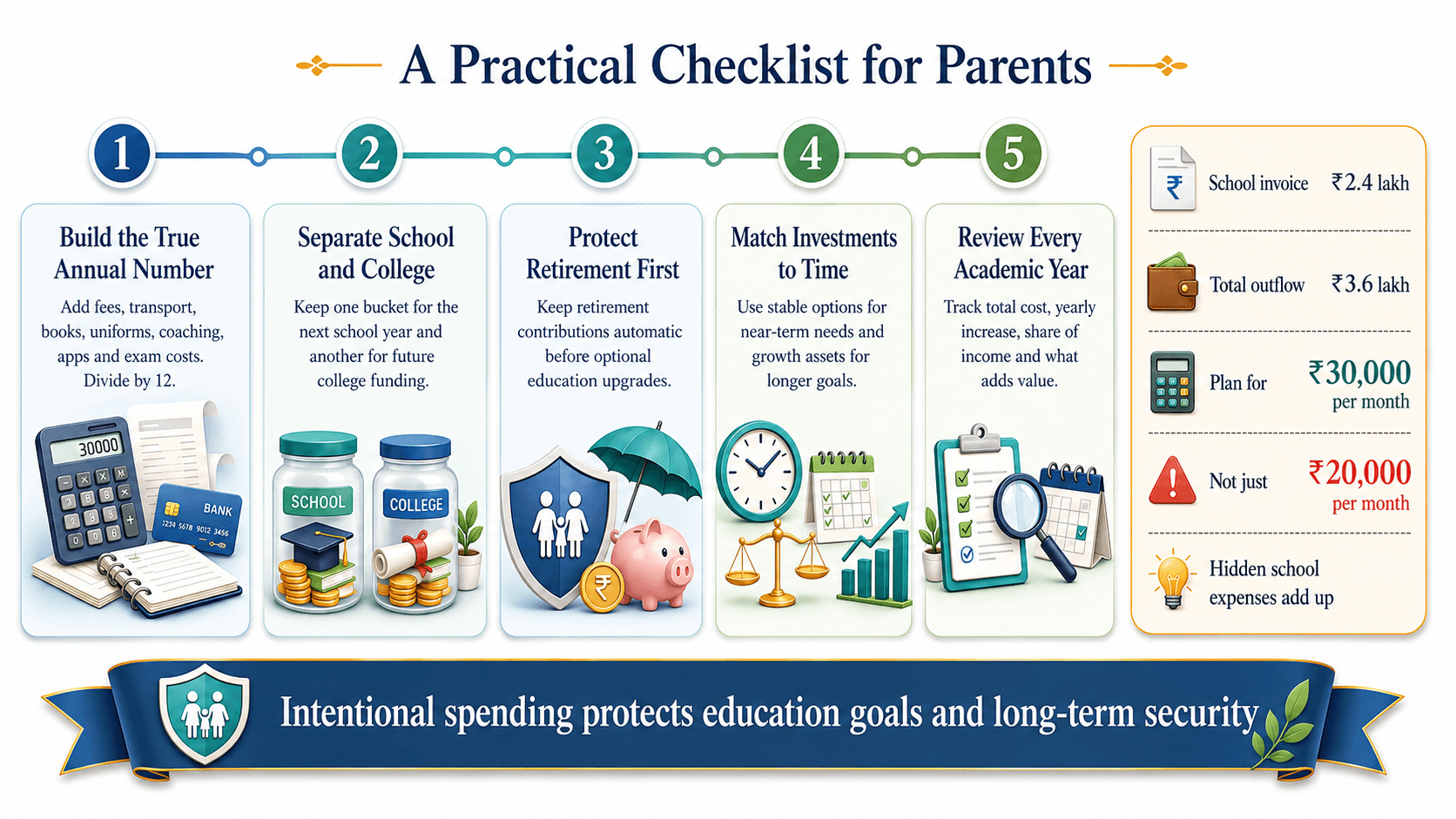
Begin by building one truthful annual number. Download twelve months of bank and card statements. Search for school payments, transport, books, uniforms, activities, coaching, educational apps, devices and exam registrations. Add everything and divide the total by twelve. This turns irregular expenses into a realistic monthly cost.
If the school invoice is ₹2.4 lakh but the complete annual outflow is ₹3.6 lakh, the family should plan around ₹30,000 a month, not ₹20,000. The difference represents the hidden school expenses that usually arrive without a dedicated budget.
Next, separate current schooling from future education. Create one savings bucket for the next academic year and contribute monthly, turning re-opening expenses into planned withdrawals. Keep college funding separate. Otherwise, every increase in private school fees may consume money intended for a goal that is still years away.
Then protect retirement before making optional upgrades. Retirement is easy to postpone because it feels distant. Yet parents cannot take a retirement loan in the way a student may access scholarships or education loans. Keep a minimum retirement contribution automatic, and review optional add-ons before interrupting it.
Match investments to the time available. Money needed within a year or two should not depend on the market being favourable on one exact payment date. Longer-term goals may use diversified growth assets depending on risk capacity and time horizon. SEBI similarly emphasises matching investments with goals, risk tolerance and investment horizon.
Finally, run one education review before every academic year. Track the annual cost, its increase, its share of income and its effect on retirement and emergency savings. Then ask which expenses created genuine value.
Did the activity improve a skill the child enjoys? Was the annual subscription used? Is coaching solving a learning need or simply following peer pressure? This is intentional spending, not cost-cutting for its own sake.
The cost of education in India may keep rising, but a family that measures the whole bill can decide what to protect, what to question and what to fund without guilt.
The strongest education plan begins with a clear boundary around the money that must remain untouched. But the hardest boundary is often the family conversation parents avoid having.
The family conversation around hidden school expenses
Many parents avoid discussing education costs because the conversation feels emotionally uncomfortable. No parent wants a child to interpret budgeting as a lack of support or a limit on opportunity.
But children also learn from the way adults make choices. A family can say yes to an important programme and no to a low-value add-on. It can show that education planning and retirement planning are not competing acts of love.
The useful question is not whether the family is spending too much. It is whether the annual household income spent on education is visible, intentional and sustainable.
If today’s education bill doubled over the next decade, would retirement savings and emergency funds survive? Would the family still have room for healthcare, elder care and its own future?
Those questions are not pessimistic. They are protective. Because education should expand a child’s choices without quietly reducing the choices available to the parents who paid for it.
And the next fee circular may be the right moment to begin that conversation differently!

Pockvue Solutions Private Limited
#1, CRE Spacez, 2nd Floor, 14th Main Road,
Sector 5, HSR Layout, Bengaluru - 560102