

India’s economic growth is often seen as a sign of progress and a source of national pride. We hear about rising GDP numbers and new global rankings, and many believe this means better opportunities for everyone. But what does it really mean for India to become the world’s fourth-largest economy? Some people expect instant benefits, while others wonder if this change will truly reach ordinary families. From the excitement of passing Japan to the challenges that still remain, India’s new position brings both hope and questions. In this blog, we’ll look at how India reached this milestone, what pushed the growth, the hurdles along the way, and what this new global status could mean for the future.
India has overtaken Japan to become the world’s fourth largest economy in 2025, with its GDP now surpassing $4 trillion, as confirmed by the International Monetary Fund (IMF) and announced by NITI Aayog. This is a major milestone in India’s economic journey, placing it just behind the United States, China, and Germany. Despite global uncertainties and internal challenges, India has shown remarkable resilience and steady growth.
India’s economic journey: from 10th to 4th
India’s rise has been steady but not without hurdles. From 2004 to 2014, the Indian economy tripled in size, driven by economic liberalisation, a booming IT sector, and strong investments. However, from 2014 to 2024, growth slowed somewhat due to events like demonetisation in 2016, the introduction of GST in 2017, the COVID-19 pandemic, and global supply chain disruptions. Even with these setbacks, India’s GDP more than doubled in the past decade, moving from about $2 trillion in 2014 to over $4 trillion in 2025.
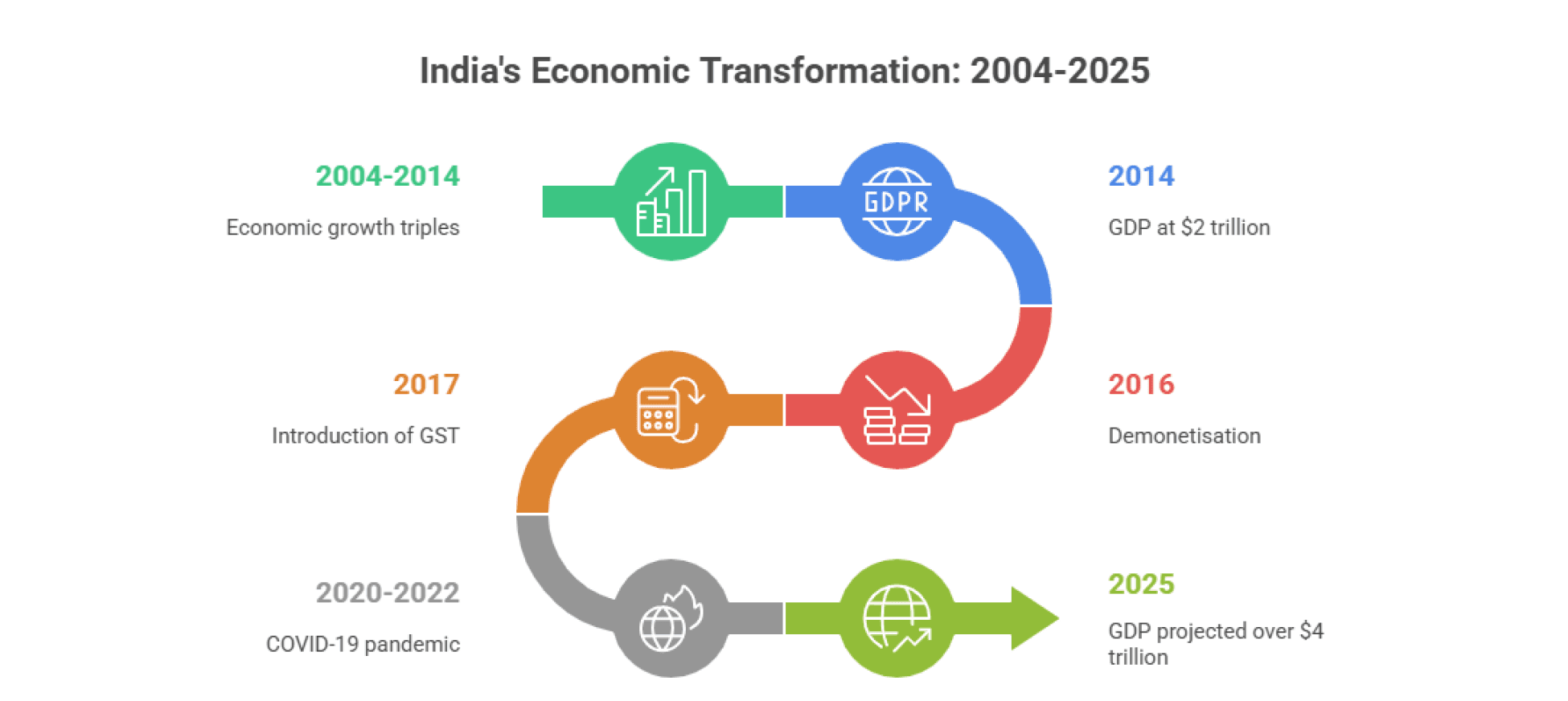
How India surpassed Japan
For many years, Japan held the fourth spot in the world’s economic rankings. In 2024, India was still behind Japan, but by 2025, India’s GDP reached about $4.19 trillion, just ahead of Japan’s $4.18 trillion. This change happened because India’s economy grew much faster, at a rate of over 6%, while Japan’s growth was less than 1%. India’s strong domestic demand, young workforce, and steady investments helped it move ahead.

Major drivers of growth
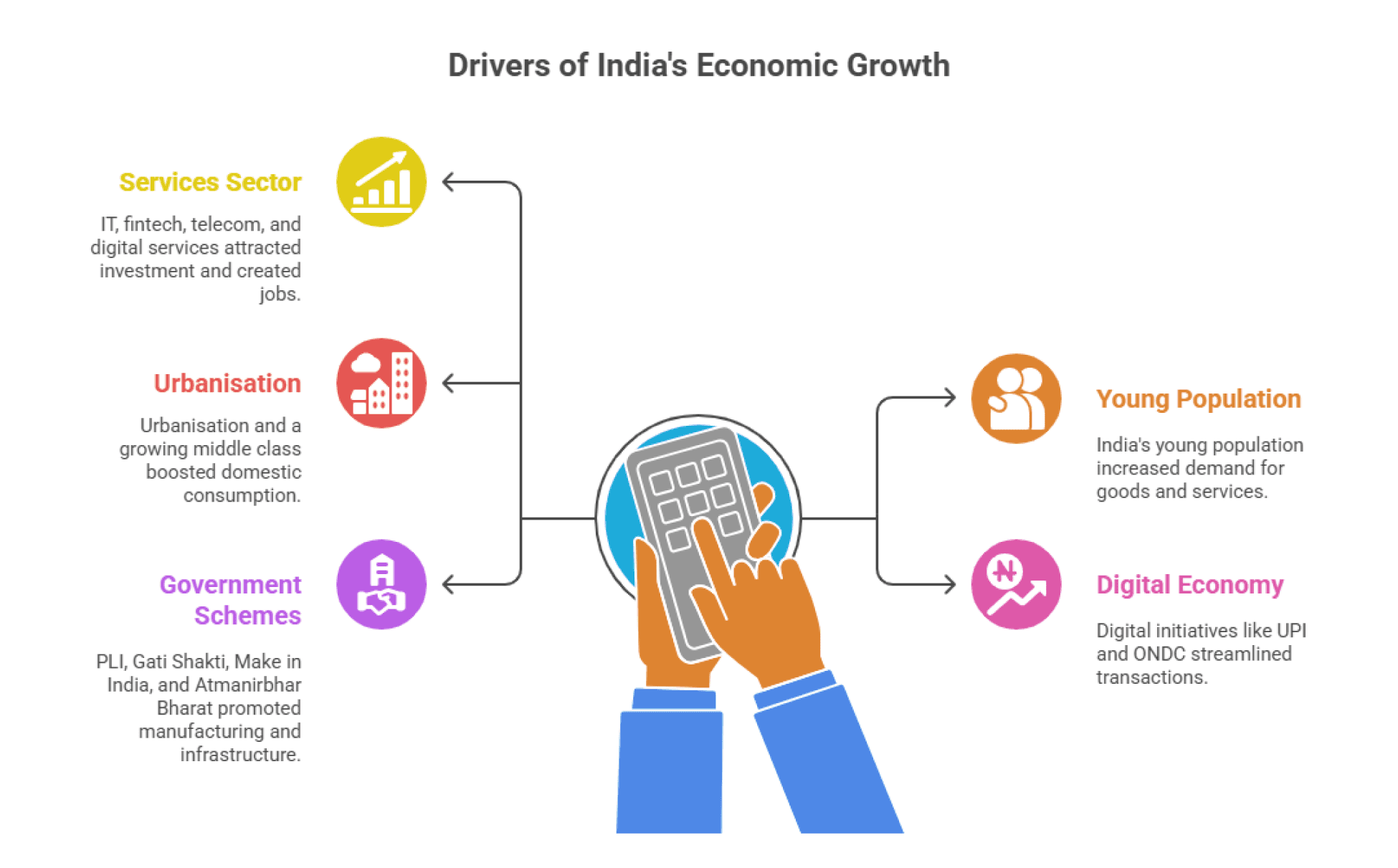
Several important factors have powered India’s economic rise:
The services sector, especially IT, fintech, telecom, and digital services, brought in investment and jobs.
India’s young and growing population increased demand for goods and services.
Urbanisation and a growing middle class led to higher domestic consumption.
The digital economy, including UPI, ONDC, and government digital schemes, made transactions easier and more efficient.
Government schemes like the Production Linked Incentive (PLI), Gati Shakti Yojana, Make in India, and Atmanirbhar Bharat encouraged manufacturing, infrastructure, and self-reliance.
Role of government reforms
The government played a key role in supporting growth. Reforms like the Goods and Services Tax (GST) made it easier to do business across the country. Other programs, such as Make in India and Atmanirbhar Bharat, pushed for more local manufacturing and less reliance on imports. The PLI scheme attracted new investments, while infrastructure projects improved roads, railways, and urban areas.
India’s economic numbers: nominal GDP vs. PPP
There are two main ways to measure an economy’s size:
Nominal GDP uses current exchange rates to compare economies in US dollars. By this measure, India is now the fourth largest economy, with a GDP of about $4.19 trillion in 2025.
Purchasing Power Parity (PPP) adjusts for the cost of living and shows what people can actually buy with their money. By PPP, India has been the third largest economy since 2009, with a GDP of about $15 trillion in 2025.
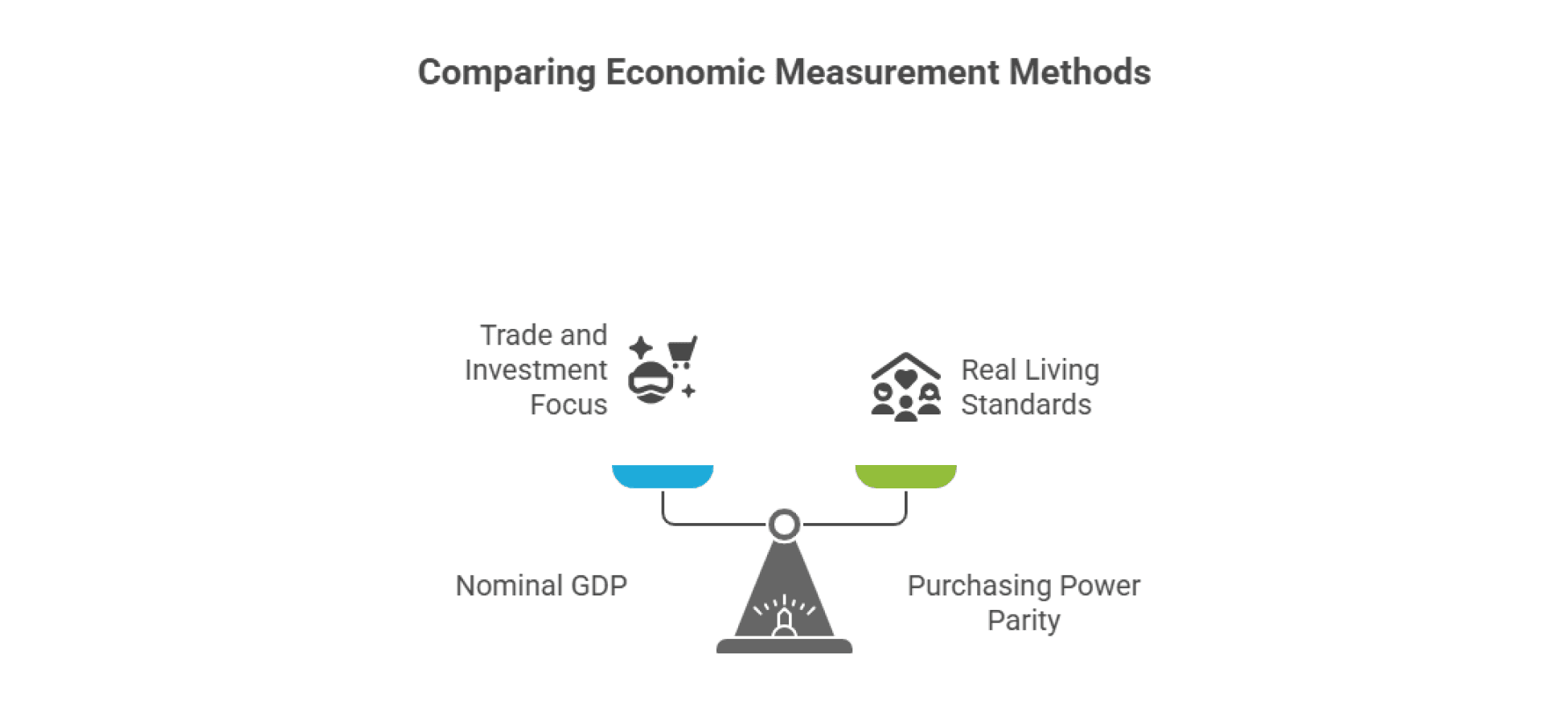
Nominal GDP is important for trade and investment, while PPP gives a better idea of real living standards.
Challenges along the way
Even with this big achievement, India faces many challenges:
Income is not shared equally, and many people still live in poverty.
There are gaps in health, education, and job opportunities, especially between cities and villages.
Unemployment and underemployment remain concerns for the growing workforce.
Global problems like inflation, trade tensions, and supply chain issues can affect India’s growth.
What lies ahead
Experts believe India’s growth will continue. The IMF projects that India could become the third largest economy by 2028, overtaking Germany, if current trends continue. For this to happen, India needs to keep investing in education, health, and infrastructure and make sure growth benefits everyone. India’s new global status brings hope but also a responsibility to ensure that progress reaches all its people.
How do you think this historic milestone will impact everyday life in India?

Newly Launched


Pockvue Solutions Private Limited
#1, CRE Spacez, 2nd Floor, 14th Main Road,
Sector 5, HSR Layout, Bengaluru - 560102